10 Massages and Stretches for a Frozen Shoulder
June 15, 2023

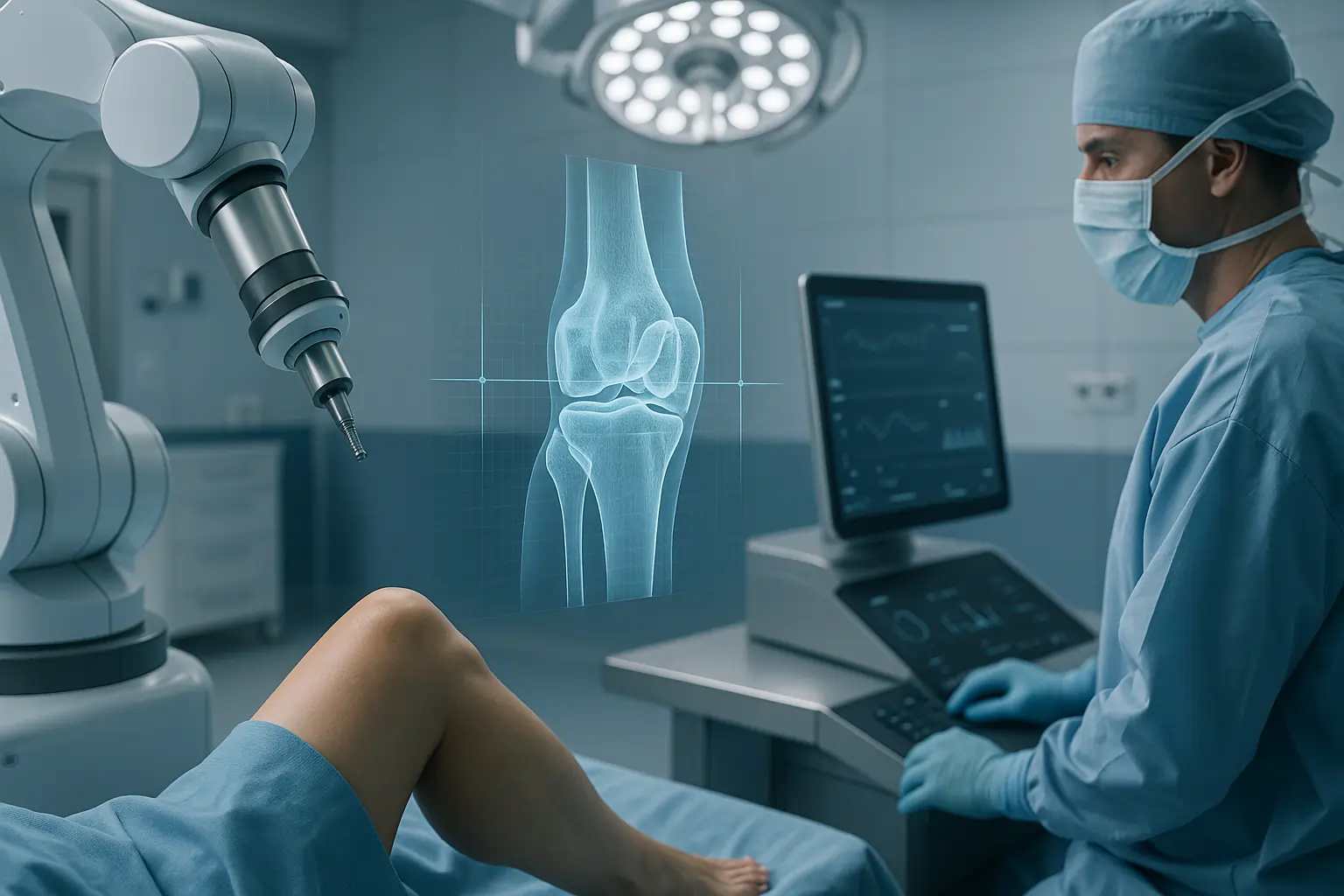
Robotic 3D mapping is a computer-guided knee replacement method where surgeons use personalized digital models created from CT scans to plan and perform bone cuts with precision measured in millimeters, resulting in better implant alignment, faster healing, and longer-lasting results.
Your knee hurts. Walking feels like a chore. Your orthopedic surgeon in Hyderabad mentions knee replacement. You nod along, but deep down you're worried about pain, recovery time, and whether the new knee will actually work.
Here's the hard truth: traditional knee replacement surgery works, but it leaves room for human error.
When a surgeon performs a manual knee replacement, their success depends on their skill, experience, and, let's be honest, how their hands feel that particular day. A deviation of just 3 degrees in implant placement can lead to uneven wear, more pain down the road, and the possibility you'll need another surgery in 10 or 15 years.
Most people don't realize this. They think knee replacement is knee replacement. They don't ask about precision levels or surgical accuracy percentages. They just want the pain gone.
But accuracy matters a lot.
At Germanten Hospital, we recognized this problem years ago. We asked ourselves what if we could remove the guesswork? What if surgeons had a digital roadmap, personalized for your exact knee anatomy, guiding them through every cut and placement decision?
That's where German technology changed everything.
Germany has built its reputation on precision for over a century. When you think of German engineering, you think of watches that run for decades, machines that never break down, systems that work the same way every single time.
The same philosophy applies to German medical technology.
Germanten Hospital brought this same precision-focused approach to orthopedic surgery. Our robotic 3D mapping system combines German-engineered hardware with cutting-edge software that learns from thousands of successful procedures. The result: knee replacements that work better and last longer.
But what does "better" actually mean when you're the patient?
Better means less pain. Better means walking without limping within days, not weeks. Better means your new knee moves and feels like it should. Natural, smooth, pain-free. Better means you don't need a second surgery in ten years because the implant wore out unevenly.
Let's break this down into steps that make sense.
Before surgery, you get a CT scan. This isn't a regular X-ray. A CT scan creates hundreds of images that the computer stitches together into a 3D model. Think of it like a digital blueprint of your exact knee: bone shapes, angles, damage patterns, everything.
Your surgeon reviews this 3D model on a screen. They see your knee from every angle. They plan exactly where to cut bone, exactly how to position the implant, exactly how to balance the ligaments. This plan is specific to your anatomy. It's not a generic approach we use on every patient.
During surgery, the robotic system guides your surgeon's tools. When the surgeon is about to cut bone in the wrong place or at the wrong angle, the robot stops them. The system provides haptic feedback (vibration and resistance) that keeps the surgical instruments exactly on the planned path.
This isn't about the robot doing the surgery. Your surgeon still does the surgery. The robot just makes sure every move is precise.
If something unexpected appears during surgery (unusual bone structure, previous fractures, unusual positioning), the system adapts in real time. The plan updates. The robot guides your surgeon based on what they're actually seeing, not just the pre-operative scan.
Here's where the data gets interesting.
Traditional manual knee replacement achieves proper alignment in about 70 percent of cases. Conventional computer navigation improves that to 87 percent. Robotic 3D mapping reaches 99.9 percent.
That's not a small difference.
Let's look at long-term outcomes. Patients who received robotic-guided knee replacements show 98.7 percent implant survival rates at 17 years. Patients with traditional surgery show 95.2 percent. That might sound like a small gap, but it means 30 fewer people out of 1,000 needing a second surgery.
Recovery time tells a similar story. Most patients walk the day of surgery with robotic guidance. Pain levels drop dramatically within 48 hours. Hospital stays shrink from 4-6 days to 2-3 days. You're back to normal activities in 2-4 weeks instead of 4-8 weeks.
For someone who loves to travel or wants to return to their grandkids quickly, that difference matters.
When you search for an orthopedic hospital in Hyderabad offering robotic knee replacement, you'll find us early in the results. There's a reason.
We brought German precision technology to Hyderabad when most hospitals were still doing manual procedures. Our surgical team, led by Dr. Mir Jawad Zar Khan with 22+ years of experience and over 10,000 joint replacements, doesn't just understand the technology. We invented how it works best for Indian patients.
We're not following trends. We're setting them.
Our orthopedic consultation in Hyderabad includes a detailed conversation about whether robotic guidance is right for you. We're honest about this. Some patients are perfect candidates. Some would do fine with traditional methods. Our job is to give you the information to decide.
Maria, 58, came to us with bone-on-bone knee arthritis. She'd been managing pain for five years. She walked with a cane. Her orthopedic clinic near me in Hyderabad had told her she wasn't ready for surgery yet, but the pain was getting worse.
We recommended robotic 3D mapping. Three weeks later, she was gardening without a cane. Six weeks later, she took a weekend trip, something she hadn't done in years.
Rajesh, 64, had sports injuries treatment in Hyderabad after a cricket accident decades ago. That old injury never healed properly. His knee developed uneven wear patterns. Traditional surgeons would have found the surgery challenging with non-standard anatomy. For our robotic system, it was just data to work with. The surgery took 25 minutes. He walked the same day.
These aren't exceptional cases. They're typical.
When you research knee replacement options, you'll hear about robotic systems from other hospitals. Some use Mako. Some use ROSA. Some still do manual procedures and call themselves “state-of-the-art.”
Here's what matters: not all robotic systems are created equal.
The best knee replacement doctor in Hyderabad isn't just someone with a robot. They're someone who understands the technology deeply, who has done thousands of cases, and who knows when to use it and when a different approach works better.
Some hospitals market robotic surgery as the only option. We market it as the best option for the right patient.
Some hospitals charge premium prices just because they have a robot. We charge what the technology is actually worth. High volume means lower per-patient cost. Better outcomes mean you don't need revision surgery.
The real competition isn't between hospitals. It's between precision and guesswork. When you walk into an orthopedic emergency care facility, you deserve precision.
Wrong assumption. The robot doesn't replace your surgeon. Your surgeon uses the robot the way a master craftsman uses precision tools. The robot removes variability. It keeps your surgeon from making mistakes. Your surgeon still makes all the decisions.
Our systems have redundancy built in. Our surgeons are trained to complete any procedure manually if needed. We've never had a case where a malfunction disrupted care. But even if one did, we're prepared.
Most insurance plans cover robotic-guided knee replacement the same way they cover traditional surgery. The cost difference is usually small. The real saving comes from fewer complications and revision surgeries down the road.
No. There are 15 years of clinical data from hospitals worldwide. Peer-reviewed studies. Long-term outcome tracking. This isn't experimental. This is proven medicine getting better results.
When you're thinking about orthopedic surgery, you're not just thinking about money, though that matters too.
You're thinking about time away from work. Time away from family. Pain you can't escape. Mobility you've lost. Adventures you've postponed.
Traditional knee replacement costs less upfront. But if it fails in year 12, you need another surgery. That's months of pain, months recovering, thousands more in costs. Not just medical, but in lost time and opportunity.
Robotic 3D mapping costs slightly more today. But it lasts longer, works better, and you don't need a do-over.
The best orthopedic hospital in Hyderabad doesn't just think about your surgery day. We think about your life 15 years from now.
Not every knee problem needs robotic guidance. Here's what makes someone an ideal candidate.
Our orthopedic surgeon in Hyderabad will do imaging, ask questions, and give you an honest assessment. If traditional surgery would serve you just as well, we'll tell you that. We're not here to sell you the most expensive option. We're here to give you the best option.
The story doesn't end when you leave the hospital.
Most patients start walking the day of surgery. Physical therapy begins immediately with gentle movement to prevent stiffness. By day three, you're often home. By week two, you're doing light activities. By week four, most people are back to normal life.
We provide detailed aftercare instructions. We're available for questions. We schedule follow-up appointments at regular intervals: two weeks, six weeks, three months, one year.
Long-term, you'll need to avoid high-impact activities (running, jumping). You'll need to stay at a healthy weight. You'll need to protect your knee from injury. Do these things, and your robotic knee replacement will likely outlast you.
At Germanten Hospital, we're not just offering knee surgery. We're offering precision, durability, and a return to the life you want to live.
When you search for an orthopedic hospital in Hyderabad, you'll find many options. When you visit for an orthopedic consultation in Hyderabad, you'll hear similar promises from different hospitals. When you ask about sports injuries treatment in Hyderabad or orthopedic emergency care, the options multiply.
But when you want results, real results, backed by data, delivered by experienced surgeons using German precision technology, you come to Germanten.
We brought robotic 3D mapping to Hyderabad because we believed patients deserved better than guesswork. We've done thousands of procedures. We've watched patients return to travel, sports, family activities, and work they thought they'd lost.
That's what German technology means: a better knee, better results, better life.
If your knee pain is holding you back, don't wait another year. Schedule an orthopedic consultation with our team. We'll assess your situation, explain your options, and answer every question you have.
The best knee replacement doctor in Hyderabad isn't someone who pushes surgery on everyone. It's someone who helps you find the solution that works best for your specific situation.
Visit us today. Walk better tomorrow.
Germanten Hospital: German Precision. Indian Care. Better Results.