10 Massages and Stretches for a Frozen Shoulder
June 15, 2023

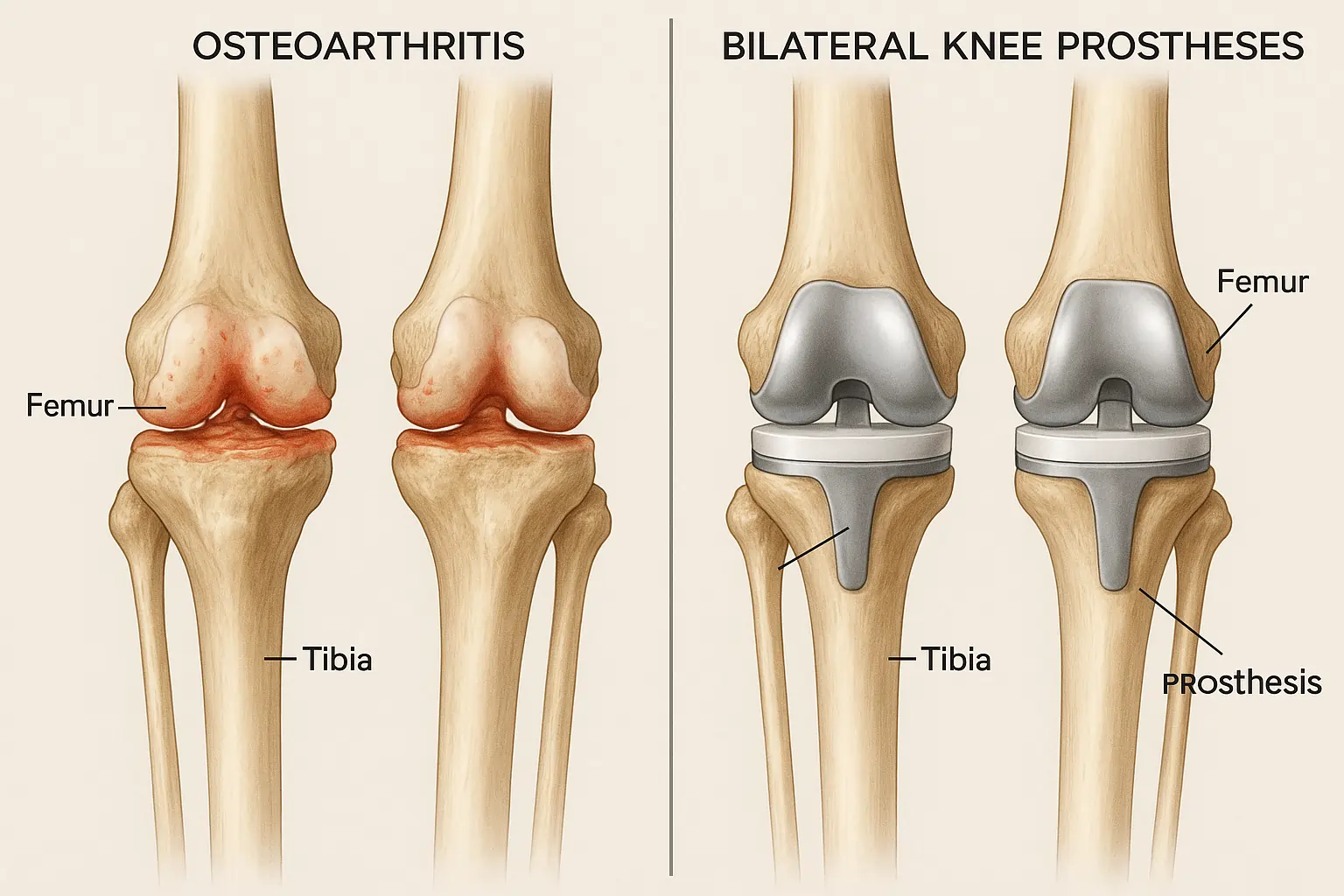
Bilateral knee replacement means having both knees replaced in one surgery or two separate surgeries. Your choice depends on your health, pain level, and lifestyle needs. This decision requires careful thought with your orthopedic doctor.
When both your knees hurt from arthritis, you face a big decision. Should you get both knees replaced at the same time? Or should you wait and do them separately? This question brings many patients to our office at Germanten Hospital, where our best doctors for orthopedic in Hyderabad help people understand their choices.

Bilateral knee replacement means replacing the damaged cartilage in both knees. Some patients get both surgeries done on the same day. Others prefer to wait weeks or months between surgeries. Neither choice is wrong. Your best choice depends on you: your age, your health, your job, and your support at home.
Let's break down what happens with each option so you can talk smart with your orthopedic doctors Hyderabad about what makes sense for your life.
A knee replacement takes about 2 hours when doctors do one knee. When they do both knees at once, the surgery takes 3 to 4 hours. The surgeon removes the damaged bone and cartilage. Then they put in a new knee made of metal and plastic.
Here's the key difference: With one surgery for both knees, you get one dose of anesthesia. With two surgeries, you get anesthesia twice. This matters because anesthesia affects your whole body, not just your knees.
Our knee replacement surgeon in Hyderabad team explains this carefully to each patient because it changes everything about your recovery.
When you do both knees together, your recovery takes about 13 weeks before you feel mostly normal. When you do them separately, you need 8 to 12 weeks for each knee. That's two separate recovery periods. Adding them up, staged surgery means you lose more time from work, more time from your family, and more time feeling stiff and sore.
Think about it this way: Your boss might give you one 3-month leave. But not two 3-month leaves six months apart. Getting both knees done together solves this problem.
Bilateral surgery costs 18% to 36% less than having two separate surgeries. Why? You pay for one hospital stay instead of two. You pay one surgery fee instead of two. Your insurance deductible applies once, not twice. If your surgery costs Rs. 2.8 lakhs for one knee, doing both together might cost Rs. 3 lakhs to Rs. 4 lakhs instead of Rs. 5 lakhs. That's real savings.
Patients at Germanten Hospital often tell us this matters for their family's budget. When you're the best hospital for knee replacement in Hyderabad, you also help people understand the money side of their decision.
With staged surgery, your first knee heals for weeks. During that time, you lean hard on your second knee. This bad knee gets extra stress while your good one rests. That extra work can actually make your bad knee feel worse.
When you do both knees together, they both rest and heal at the same speed. This balanced healing means you get the same motion in each knee and the same strength. You don't end up with one knee that moves 120 degrees and another that only bends 100 degrees.
Every time you get anesthesia, your body takes a small hit. Your heart works harder. Your lungs work differently. Your brain needs time to wake up. Older people feel this more. Doing both knees at once means your body only goes through this once instead of twice.
This is the biggest challenge nobody talks about enough. With one knee replaced, you have one good leg to stand on while the bad leg heals. You can lean on that good leg during physical therapy. You can walk to the bathroom without too much trouble.
With both knees replaced, you have no good leg. You can't stand on either one. You can't lean on a strong leg. You can't go to the bathroom alone. Everything you do in those first weeks requires help or equipment. This isn't just hard physically: it's hard mentally. Patients tell us they felt scared and helpless after bilateral surgery in a way they never expected.
Most people with bilateral surgery need to stay in a rehabilitation hospital for 2 to 3 weeks after their main hospital stay ends. That's an extra facility. That's extra cost. That's more time away from home.
When surgeons operate on two knees, they cut more tissue. More cutting means more bleeding. About 40% of bilateral patients need a blood transfusion. For single knee surgery, only 12% need transfusions. That's a big difference.
Blood transfusions are safe in modern hospitals. But they still carry small risks. Doctors at our best knee replacement hospital in Hyderabad make sure we have blood ready and watch patients closely.
Serious problems happen in 3.8% of bilateral surgeries. For single knee surgery, complications occur in 2.2% of cases. That's almost twice as often. Complications include infection, blood clots, stiffness, and damage to blood vessels or nerves.
The biggest worry after any knee surgery is blood clots. A blood clot can form in your leg vein. Doctors call this a DVT. If that clot travels to your lungs, it becomes a PE, which can be deadly.
Here's what matters: Blood clot risk is 8 times higher after bilateral surgery than after single knee surgery. Eight times. This isn't a small difference.
Doctors prevent this by giving blood thinner medication, having you wear compression stockings, and getting you moving as soon as possible. Our orthopedic doctors in Hyderabad watch for warning signs like swelling, warmth, or pain in your calf.
Two surgeries means two painful spots instead of one. Your pain will be stronger at first. Stronger pain makes it harder to do your physical therapy. And physical therapy is what gets you better.
The good news: By 8 to 12 weeks, most patients feel much better. But those first few weeks are tough.
Days 1-3 (Hospital): You're in the hospital. Nurses help you walk with a walker. You
start bending your knees gently. This hurts, but it's important.
Weeks 1-2 (Rehabilitation Facility): You bend your knees to 70 to 90 degrees. You
walk a little more each day. Physical therapists work with you twice a day. You're still in a
facility because you can't manage at home yet.
Weeks 3-6: You switch from walker to cane. You can climb stairs slowly. You might go
home now if someone can help you. You start desk work if your job allows it.
Months 2-3: You walk without a cane. You're almost independent. Pain drops
significantly. You see real progress now.
Months 4-6: You can do most normal activities. Kneeling is still uncomfortable. You
can golf or swim. Your strength keeps growing.
Months 7-12: Full recovery hits. Your knees bend 120 to 130 degrees. You can do
almost everything you did before arthritis. You might still avoid running or jumping, but life feels
normal.
You're a good candidate for bilateral knee replacement if:
You should probably choose staged surgery if:
Talk with our knee replacement surgeon in Hyderabad team about where you fit. This decision is personal.
One bilateral knee replacement typically costs Rs. 3 lakhs to Rs. 4 lakhs. This includes surgery, hospital stay, anesthesia, and the artificial knees. Two separate surgeries cost Rs. 3.5 lakhs to Rs. 5 lakhs. You save money with bilateral surgery.
Your insurance usually covers most of this. Medicare covers it for people 65 and older. Your out-of-pocket cost depends on your plan's deductible and copay.
Don't forget: Rehabilitation facility stays add another Rs. 50,000 to Rs. 1.5 lakhs if you need them. Most bilateral patients do.
Before you decide, ask:
Our best doctors for orthopedic in Hyderabad at Germanten Hospital make
sure you understand every part of this decision before you commit.
| Factor | Bilateral Surgery | Staged Surgery |
|---|---|---|
| Surgery time | 3-4 hours | 2 hours each |
| Hospital stay | 4-10 days | 4-7 days per surgery |
| Recovery time | 13+ weeks total | 8-12 weeks per knee |
| Cost | Rs. 3 lakhs - Rs. 4 lakhs | Rs. 3.5 lakhs - Rs. 5 lakhs |
| Blood transfusion rate | 40% | 12% |
| Complication rate | 3.8% | 2.2% |
| Blood clot risk | 8x higher | Lower |
| Rehabilitation facility | Usually yes | Usually no |
| Time off work | 3 months | 6+ months spread out |
| Patient satisfaction | 85% | 85% |
Both approaches work well. Your choice depends on what matters most to you.
Our best hospital for knee replacement in Hyderabad, Germanten Hospital brings together top talent and modern equipment. Our knee replacement doctors in Hyderabad have trained in the world's best centers. We do both bilateral and staged surgeries safely.
We don't just do the surgery. We prepare you before. We manage your pain after. We guide your physical therapy. We check on you for years. Our orthopedic doctors Hyderabad team believes that success starts before surgery and continues long after.
Bilateral knee replacement isn't right for everyone. It's right for people who want to get their life back fast, who can handle stronger pain in the short term, and who have the health and support to recover well. If that's you, the advantages are huge: faster recovery, lower cost, and less total disruption to your life.
Staged surgery might be right if you want an easier first recovery, if you have health concerns, or if you need to spread out your time off work.
The choice is yours to make with your doctor. Our orthopedic doctors in Hyderabad at Germanten Hospital are ready to help. We'll listen to your concerns. We'll explain your options. We'll help you choose the path that makes sense for your life and your health.
Don't wait until your pain controls you. Call today and talk with one of our best doctors for orthopedic in Hyderabad. We're here to help you walk pain-free again.
Ready to take the next step? Contact Germanten Hospital today to speak with one of our best orthopedic doctors in Hyderabad. We help patients make the right choice for their knees and their lives.