10 Massages and Stretches for a Frozen Shoulder
June 15, 2023

A heart attack does not always happen like it is shown in movies. Many people imagine a heart attack as sudden crushing chest pain, collapse, or severe discomfort in the left arm. But in real life, especially in diabetic patients, heart attack symptoms can be mild, confusing, or almost unnoticeable.
This is called a silent heart attack. It may happen without severe chest pain. A person may only feel unusual tiredness, mild chest pressure, breathlessness, sweating, dizziness, nausea, indigestion, burping, or discomfort in the jaw, back, shoulder, or arm. Because these symptoms look common, many diabetic patients ignore them or treat them as acidity, weakness, stress, or gastric trouble.
That delay can be dangerous. A silent heart attack can still damage the heart muscle. It can also increase the risk of another heart attack, heart failure, irregular heartbeat, and other complications if not diagnosed on time.
If you have diabetes and are searching for a cardiologist in Hyderabad, silent heart attack symptoms, heart checkup in Hyderabad, or a heart specialist near me, this blog will help you understand what to watch for and when to seek medical help.
Germanten Hospital, Attapur, Hyderabad, provides cardiology consultation, cardiac diagnostics, and heart care support for patients from Attapur, Rajendra Nagar, Mehdipatnam, Tolichowki, Langar Houz, Nanal Nagar, Karwan, Kismatpur, Bandlaguda Jagir, Shamshabad, Manikonda, Gachibowli, Banjara Hills, and nearby Hyderabad areas.
A silent heart attack is a heart attack that happens without clear or typical symptoms. The word "silent" does not mean harmless. It means the symptoms may be absent, mild, unusual, or ignored.
In a heart attack, blood flow to a part of the heart muscle is reduced or blocked. When the heart muscle does not receive enough oxygen-rich blood, it can get damaged. In a regular heart attack, the person may feel severe chest pain, sweating, breathlessness, or pain spreading to the left arm or jaw. In a silent heart attack, the same damage may happen, but the warning signs are less obvious.
A diabetic patient may continue daily work even after mild symptoms because the pain is not strong. Sometimes, a silent heart attack is detected later during ECG, 2D Echo, stress test, or other cardiac evaluation.
Diabetes affects more than blood sugar. Over time, high blood sugar can damage blood vessels and nerves. This is one reason diabetic patients have a higher risk of heart disease.
Diabetes can contribute to:
• Damage to blood vessels
• Faster plaque buildup in arteries
• Higher risk of coronary artery disease
• High blood pressure
• High cholesterol or triglycerides
• Obesity and insulin resistance
• Kidney disease
• Nerve-related changes that reduce pain sensation
When nerves are affected, a diabetic patient may not feel heart-related pain in the usual way. This can make a heart attack harder to recognise. Instead of severe chest pain, the person may feel sweating, weakness, breathlessness, nausea, acidity-like discomfort, or mild pressure.
This is why diabetic patients should never ignore unusual symptoms, even if they appear small.

Many diabetic patients develop nerve damage over time. This is commonly known as diabetic neuropathy. Most people think neuropathy only affects the feet, causing numbness, tingling, or burning. But diabetes can also affect nerves that control internal organs, including the heart.
When pain signals are reduced or altered, a patient may not feel classic chest pain during a heart attack. The heart may still be under stress, but the body may not give a strong pain signal.
This is why silent heart attacks are especially concerning in diabetic patients. The symptoms may feel like:
• Acidity
• Gas
• Indigestion
• Mild weakness
• Sweating
• Breathlessness
• Shoulder pain
• Jaw discomfort
• Upper back pain
• Tiredness after routine activity
Because these symptoms are common in daily life, patients may not connect them with the heart. Families also may not take them seriously until the condition becomes more severe.
Silent heart attack symptoms can be subtle. They may come and go. They may last for a few minutes or feel like general discomfort. But if you have diabetes, especially long-standing diabetes, you should be alert.
Feeling tired after hard work is normal. But sudden, unexplained tiredness is not something to ignore. If a diabetic patient feels unusually weak, exhausted, or unable to do routine activities like walking, climbing stairs, or getting ready, it may be a warning sign.
This tiredness may not improve with rest. Some patients describe it as feeling drained without a clear reason.
A silent heart attack may not cause sharp pain. It may feel like pressure, tightness, heaviness, or discomfort in the chest. Some people describe it as "something sitting on the chest."
This can be mistaken for gas or acidity. But chest pressure that is new, repeated, or linked with sweating or breathlessness should be checked.
If you suddenly feel breathless while walking, climbing stairs, doing household work, or lying down, it may indicate that the heart is not pumping properly or not getting enough blood supply.
Breathlessness without chest pain is also important in diabetic patients. Do not wait for severe chest pain to appear.
Cold sweating, especially with weakness, chest discomfort, nausea, or dizziness, can be a warning sign. If a diabetic patient starts sweating suddenly without heat, exercise, or fever, cardiac evaluation may be needed.
Silent heart attacks may feel like indigestion, acidity, bloating, burping, or stomach discomfort. This is one reason many patients take antacids and delay medical care.
If indigestion-like discomfort is unusual, repeated, associated with sweating or breathlessness, or occurs in a diabetic patient with other risk factors, it should not be ignored.
Heart-related pain does not always stay in the chest. It may spread to the jaw, neck, shoulder, upper back, left arm, right arm, or upper stomach.
In diabetic patients, this discomfort may be mild. It may feel like muscle strain, dental pain, cervical pain, or shoulder stiffness.
Sudden dizziness, faint feeling, or lightheadedness can happen during a cardiac event. If it occurs with sweating, weakness, chest pressure, palpitations, or breathlessness, seek medical help.
Some patients feel their heart racing, skipping beats, or beating irregularly. Palpitations can happen for many reasons, but in diabetic patients with chest discomfort or breathlessness, they need proper evaluation.
Do Not Ignore Mild Symptoms
If you have diabetes and notice unusual fatigue, sweating, breathlessness, chest pressure, jaw pain, back pain, nausea, or indigestion-like discomfort, schedule a cardiology consultation at Germanten Hospital, Attapur, Hyderabad. Early evaluation can help identify heart risk before complications increase.
Many diabetic patients mistake silent heart attack symptoms for acidity. This happens because both conditions can cause discomfort in the chest or upper stomach.
Acidity may cause burning after food, sour taste, burping, bloating, throat irritation, and discomfort while lying down. A heart-related problem may cause pressure, heaviness, sweating, breathlessness, fatigue, pain spreading to the arm or jaw, or discomfort during activity.
The problem is that a silent heart attack may also feel like acidity or indigestion. That is why diabetic patients should not depend only on home remedies or antacids when symptoms are new or unusual.
A simple rule is: if the symptom feels different from your normal acidity, comes with sweating or breathlessness, happens during activity, or keeps returning, get your heart checked.
All diabetic patients need to be careful, but some have higher risk.
You may be at higher risk if you have:
• Diabetes for many years
• Poor blood sugar control
• High blood pressure
• High cholesterol
• Smoking or tobacco habit
• Obesity
• Sedentary lifestyle
• Family history of heart disease
• Kidney disease
• Previous heart attack
• Previous angioplasty or stenting
• Previous bypass surgery
• Numbness or neuropathy in feet
• Breathlessness during routine activity
• Abnormal ECG or previous heart test
• Age above 40
• Stressful lifestyle
• Poor sleep
• High triglycerides
If you have diabetes along with high BP and cholesterol, your heart risk becomes much higher. Do not wait for major symptoms before consulting a cardiologist.
Many diabetic patients regularly check blood sugar but ignore heart screening. This is a mistake. Diabetes and heart disease are closely connected.
A regular heart checkup can help detect early signs of cardiac stress, reduced blood flow, abnormal rhythm, or heart muscle changes. It can also help your doctor decide whether medicines, lifestyle changes, or further testing is needed.
Heart checkups are especially important if you have:
• Diabetes for more than 5 years
• High BP
• High cholesterol
• Smoking history
• Family history of early heart disease
• Breathlessness
• Palpitations
• Chest discomfort
• Reduced stamina
• Swelling in legs
• Previous abnormal ECG
• Previous cardiac procedure
For diabetic patients, prevention is better than emergency treatment.
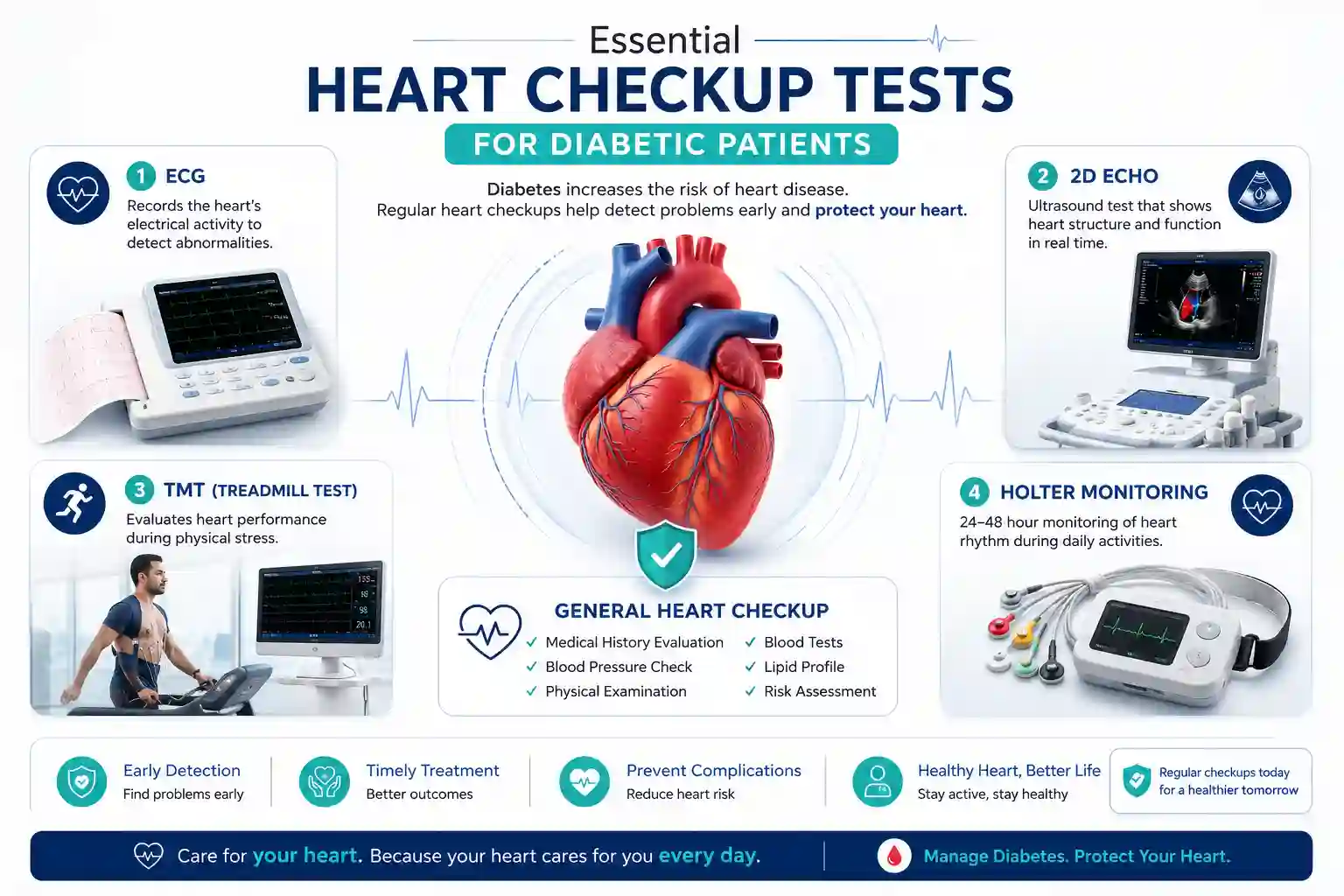
A cardiologist will first understand your symptoms, diabetes history, BP, cholesterol, lifestyle, medicines, family history, and previous reports. Based on your condition, tests may be advised.
An ECG checks the electrical activity of the heart. It may show signs of a current or past heart attack, rhythm changes, or stress on the heart.
A 2D Echo is an ultrasound of the heart. It helps check pumping function, heart muscle movement, valves, and structural problems.
A treadmill test checks how the heart performs during exercise. It may be useful in stable patients when the doctor wants to assess blood flow during physical activity.
A Holter monitor records heart rhythm for a longer duration. It can help detect irregular heartbeats that may not appear during a short ECG.
In suspected heart attack cases, blood tests may be done to check markers that rise when the heart muscle is injured.
A CT angiogram may be used in selected patients to assess coronary artery disease risk and detect narrowing in heart arteries.
If significant blockage is suspected, coronary angiography may be recommended. This test helps identify the location and severity of artery blockages.
If angiography shows a major blockage, angioplasty and stenting may be considered to open the blocked artery and improve blood flow.
If a diabetic patient develops unusual symptoms, do not dismiss them. Take the symptoms seriously.
If symptoms are severe or sudden:
Seek emergency medical help immediately. This includes chest pressure, breathlessness, sweating, fainting, severe weakness, jaw pain, arm pain, or discomfort that does not settle.
If symptoms are mild but repeated:
Book a cardiology consultation. Repeated breathlessness, fatigue, acidity-like discomfort, palpitations, or reduced stamina should be evaluated.
Do not do these things:
• Do not keep taking antacids repeatedly without evaluation
• Do not assume it is only gas
• Do not delay because there is no severe chest pain
• Do not drive yourself during severe symptoms
• Do not stop diabetes or heart medicines without doctor advice
• Do not ignore symptoms after they disappear
A symptom that comes and goes can still be heart-related.
If you have diabetes, high BP, cholesterol, or a family history of heart disease, book a heart checkup at Germanten Hospital, Hyderabad. The cardiology team can guide you with ECG, 2D Echo, TMT, Holter monitoring, and further cardiac evaluation if needed.
Many diabetic patients underreport symptoms. They may say, "It is just gas," "I am only tired," or "I will rest for some time." Family members should be alert, especially if the patient is elderly, has long-standing diabetes, or has previous heart disease.
Watch for:
• Sudden sweating
• Unusual silence or restlessness
• Breathlessness
• Weakness
• Confusion
• Chest pressure
• Jaw or shoulder discomfort
• Repeated burping with discomfort
• Sudden drop in activity level
• Feeling faint
If these symptoms appear, do not wait too long. Medical evaluation is safer than guessing.
Women with diabetes may have even more subtle symptoms. They may not always have strong chest pain. They may feel tired, breathless, nauseous, dizzy, anxious, or have discomfort in the back, jaw, neck, shoulder, or upper stomach.
These symptoms are often mistaken for acidity, weakness, menopause, stress, or household fatigue. But diabetic women should be careful, especially after menopause or if they have high BP, cholesterol, obesity, or family history of heart disease.
A sudden change in stamina, unexplained fatigue, or breathlessness during routine activity should be checked.
Silent heart attacks are concerning, but many risk factors can be managed with timely care.
Important prevention steps include:
Keep your blood sugar and HbA1c within the target range advised by your doctor. Long-term uncontrolled diabetes increases heart and blood vessel damage.
High BP puts extra pressure on the heart and blood vessels. Diabetic patients should regularly monitor BP and follow prescribed medicines.
High LDL cholesterol and triglycerides can increase plaque buildup in arteries. Regular lipid profile testing is important.
Smoking damages blood vessels and increases clotting risk. For diabetic patients, smoking further increases heart attack risk.
Walking and exercise can help improve insulin sensitivity, weight, BP, cholesterol, and heart fitness. Always ask your doctor before starting exercise if you have heart symptoms.
Choose more vegetables, fruits in controlled portions, whole grains, lean protein, nuts as advised, and less fried food, processed food, sugary drinks, excess salt, and trans fats.
Weight control helps improve diabetes, BP, cholesterol, and heart health.
Do not wait for symptoms. If you are diabetic and above 40, or have additional risk factors, ask your doctor how often you need cardiac evaluation.
Germanten Hospital, Attapur, offers advanced cardiac care in Hyderabad with diagnostic support and specialist cardiology consultation. The cardiology department provides services such as EKG, Echocardiography, Event Monitoring, Holter Monitoring, Stress Testing, and Cardiac Rehabilitation.
Dr. Mohammed Wasif Azam, Chief Consultant Cardiologist at Germanten Hospital, Hyderabad, has 33+ years of experience in cardiology and interventional cardiology. His expertise includes coronary procedures, coronary angiogram, angioplasty, stenting, heart rhythm management, pacemaker implantation, preventive cardiology, high BP, cholesterol management, heart attack, and chest pain care.
For diabetic patients with mild or confusing symptoms, experienced cardiac evaluation is important because symptoms may not always be typical.

If you are searching for a cardiologist near me, heart specialist in Hyderabad, heart checkup in Hyderabad, or cardiac hospital near me, Germanten Hospital is located in Attapur Patients from these areas can consult the cardiology team for diabetic heart risk, silent heart attack symptoms, chest discomfort, breathlessness, palpitations, high BP, abnormal ECG, heart checkups, and post-cardiac care.
If you have diabetes and are experiencing unusual fatigue, chest pressure, sweating, breathlessness, nausea, jaw pain, back pain, palpitations, or repeated acidity-like discomfort, schedule a consultation at Germanten Hospital, Attapur, Hyderabad.
A silent heart attack can be easy to miss, especially in diabetic patients. It may not cause severe chest pain. Instead, it may appear as fatigue, mild chest pressure, breathlessness, sweating, nausea, indigestion, jaw pain, shoulder pain, back pain, dizziness, or palpitations.
For diabetic patients, these mild symptoms should not be ignored. Diabetes can damage blood vessels and nerves, increasing both heart disease risk and the chance of atypical symptoms. Waiting for severe chest pain can delay important treatment.
If you have diabetes, high BP, cholesterol, smoking history, obesity, family history of heart disease, or reduced stamina, regular cardiac evaluation is important. If symptoms appear suddenly or feel unusual, seek medical help.
Germanten Hospital, Attapur, Hyderabad, provides cardiology consultation and cardiac diagnostic support for patients from Attapur, Rajendra Nagar, Mehdipatnam, Tolichowki, Langar Houz, Nanal Nagar, Karwan, Kismatpur, Bandlaguda Jagir, Shamshabad, Manikonda, Gachibowli, Banjara Hills, and nearby areas.
If you have diabetes and notice mild chest discomfort, unusual tiredness, breathlessness, sweating, nausea, jaw pain, back pain, palpitations, high BP, or abnormal ECG findings, consult the cardiology team at Germanten Hospital, Attapur, Hyderabad.
Schedule a consultation with Dr. Mohammed Wasif Azam, Chief Consultant Cardiologist, for expert cardiac evaluation and personalised treatment guidance.
A silent heart attack is a heart attack that happens without clear or typical symptoms. The person may not feel severe chest pain. Instead, they may have mild symptoms like fatigue, breathlessness, sweating, nausea, indigestion, jaw pain, back pain, or chest pressure.
Diabetes can damage blood vessels and nerves over time. Nerve damage may reduce pain signals, so a diabetic patient may not feel classic chest pain during a heart attack. Diabetes also increases the risk of coronary artery disease, high BP, cholesterol problems, and heart complications.
Diabetic patients should not ignore unusual tiredness, breathlessness, sweating, mild chest pressure, nausea, dizziness, palpitations, jaw pain, shoulder pain, upper back pain, or acidity-like discomfort that feels new or repeated.
Yes. In some patients, especially diabetic patients, a silent heart attack can feel like acidity, gas, indigestion, bloating, or upper stomach discomfort. If symptoms are new, repeated, or associated with sweating, weakness, or breathlessness, consult a cardiologist.
A cardiologist may recommend ECG, 2D Echo, TMT, Holter monitoring, cardiac blood tests, CT angiogram, or coronary angiography depending on symptoms and risk level.
A diabetic patient should visit a cardiologist if they have chest discomfort, breathlessness, palpitations, sweating, dizziness, unusual fatigue, high BP, high cholesterol, abnormal ECG, or family history of heart disease. Regular heart screening is also important for long-standing diabetes.
Yes. Germanten Hospital is located in Attapur, Hyderabad, and is accessible for patients from Rajendra Nagar, Mehdipatnam, Tolichowki, Langar Houz, Nanal Nagar, Karwan, Kismatpur, Bandlaguda Jagir, Shamshabad, Manikonda, Gachibowli, Banjara Hills, and nearby areas.
American Heart Association: Warning Signs of a Heart Attack