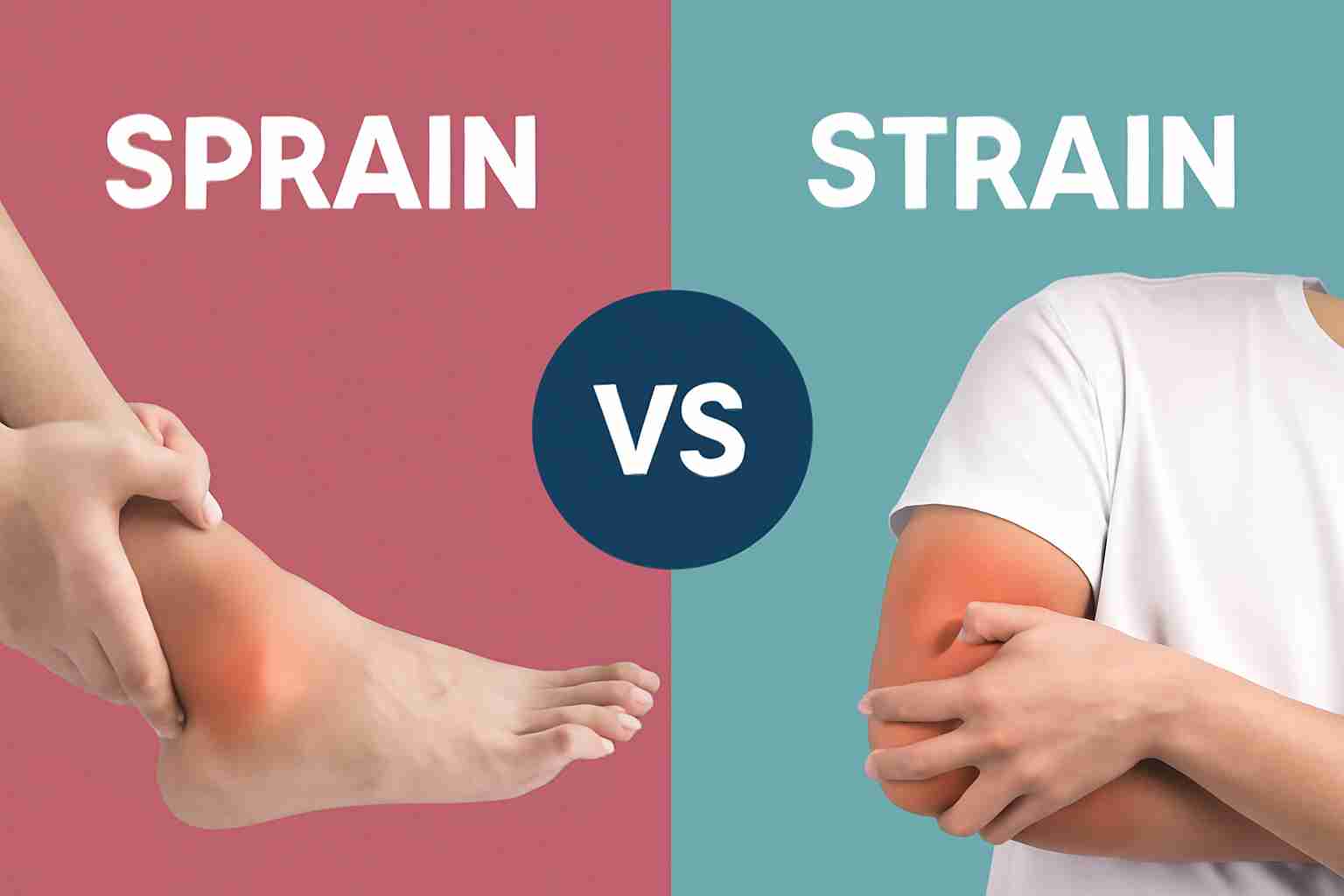
Imagine you’re running for the bus, your foot catches on the pavement, and you twist your ankle. You
hobble home, hoping it’s nothing serious, but you aren’t sure. Is it a sprain? Or is it a strain?
The terms are often used interchangeably, but they actually refer to different injuries that affect
different parts of your body.
Understanding whether you’re dealing with a sprain or a strain can help guide your treatment,
recovery time, and even prevent long-term damage. Let’s dive into the key differences between these
two common injuries and what you can do about them.
What is a Sprain?
What Is a Sprain?
A sprain is an injury to a ligament, which is the tissue that connects bones at a joint. Ligaments
play a crucial role in providing stability and limiting movement, and when they are overstretched or
torn, they can cause significant discomfort.
Common areas affected by sprains include the ankles, wrists,
and knees, as these joints are often subjected to excessive force, twisting
motions, or falls. Sprains occur when a joint is pushed out of its normal range of motion, either
through a sudden movement, an awkward twist, or a heavy impact.
How Does a Sprain Happen?
A sprain occurs when the ligament stretches or tears due to trauma or force that exceeds its normal
capacity. This can happen through:
Twisting motions (e.g., stepping
awkwardly on uneven surfaces)
Falling and landing badly on a
joint.
Sudden direction changes (e.g., while
playing sports or running).
Excessive force (e.g., lifting something
too heavy for your joint).
Symptoms of a Sprain:
Sprains typically come with several distinct symptoms:
Pain around the joint: Pain is usually
sharp and can become more intense when moving or touching the area.
Swelling: This happens due to fluid
buildup from the injury and can cause the affected area to appear larger than normal.
Bruising: Damaged blood vessels under the
skin may cause visible discoloration.
Joint instability: Severe sprains can
lead to weakness or an inability to stabilize the joint, resulting in it feeling loose or
wobbly when trying to use it.
What is a Strain?
What Is a Strain?
A strain is an injury that affects a muscle or tendon, which connects muscles to bones. Unlike
sprains, which affect the joints, strains primarily involve the muscle and tendon tissues. Strains
can occur when a muscle or tendon is overstretched or torn due to excessive force or overuse.
Strains are most common in areas like the lower
back, hamstrings, and shoulders —
muscles that experience a lot of stress during movement.
How Does a Strain Happen?
Strains often happen in the following ways:
Overuse: Repeating the same movement too
often (like running, lifting, or bending) without proper rest or stretching.
Sudden movements: Quick actions, like
pulling or jerking, that put too much stress on muscles.
Incorrect posture or lifting technique:
When muscles are strained by improper body mechanics, especially during lifting tasks or
repetitive motions.
Symptoms of a Strain:
Muscle pain: This pain can range from
mild to severe, and it usually worsens with movement.
Swelling: Like sprains, strains can cause
swelling around the injured muscle.
Muscle spasms: The muscle may feel tight
and may spasm as it tries to contract.
Weakness: Depending on the severity, a
strain can weaken the muscle, making it hard to perform normal movements.
Sprain vs Strain: The Key Differences
In this section, we compare sprains and strains side by
side to highlight the key differences. We use a comparison table to visually
organize the information for easy understanding.
Sprain vs Strain: The Key Differences
Feature
Sprain
Strain
What is
injured?
Ligaments (connect
bones)
Muscles or tendons
(connect muscles to bones)
Common
causes
Sudden twisting,
falls, awkward movements
Overuse, lifting,
sudden overstretching
Symptoms
Pain, swelling,
bruising, joint instability
Pain, swelling, muscle
spasms, weakness
Treatment
Rest, ice,
compression, elevation (RICE); severe cases may need surgery
Rest, ice,
compression, stretching, rehab
Differences Explained:
What is injured?
Sprain: Ligaments are affected,
leading to potential instability in the joint.
Strain: Muscles or tendons are
injured, leading to weakness, pain, and spasms.
Common causes:
Sprain: Happens from sudden
twisting, falls, or accidents where the joint moves beyond its normal range of
motion.
Strain: Caused by overuse or
sudden forceful movements that stretch or tear muscle fibers or tendons.
Symptoms:
Sprain: Includes pain, swelling,
bruising, and joint instability.
Strain: Includes muscle pain,
swelling, spasms, and weakness.
Treatment:
Sprain: Often treated with
R.I.C.E (Rest, Ice, Compression, Elevation), and in severe cases, surgery or
physical therapy may be necessary.
Strain: Requires rest, ice,
gentle stretching, and strengthening exercises. Severe cases may require
rehabilitation.
What Most People Don’t Realize About Sprains and Strains
1. Severity Matters More Than the Label
The severity of the injury is more important than whether it’s labeled a sprain or strain. A minor
sprain can be easier to recover from than a severe strain, and vice
versa. Severity plays a key role in determining treatment and recovery time.
2. Chronic Problems From Mild Sprains or Strains
If not treated properly, even a mild sprain or strain can lead to chronic
problems:
Sprains can lead to joint instability,
which might make you prone to future sprains in the same area.
Strains can weaken muscles and cause
chronic pain or re-injury if not rehabilitated correctly.
3. People Often Misdiagnose Their Injury
It’s easy to confuse a mild sprain with a strain, and vice versa. Misdiagnosis
can result in improper treatment. For example, resting a strain may seem like the right choice, but
some strains require gentle stretching and gradual strengthening, while sprains might need more
joint support and immobilization.
How to Treat a Sprain vs a Strain
Treatment for a Sprain:
Rest: Avoid using the affected
joint.
Ice: Reduce swelling and numb the
pain.
Compression: Use an elastic bandage or
brace to control swelling.
Elevation: Elevate the injured limb above
heart level to reduce swelling.
Rehabilitation: Severe sprains may
require physical therapy to regain strength and stability in the joint.
Treatment for a Strain:
Rest: Give the muscle time to heal by
avoiding the activity that caused the strain.
Ice: Apply to the injured area to reduce
swelling.
Compression: Use a bandage to reduce
swelling.
Gentle Stretching: Once the pain
decreases, start with gentle stretches to restore flexibility.\
Strengthening Exercises: Strengthen the
affected muscle with targeted exercises to prevent future strains.
How to Prevent Sprains and Strains
Warm-up before physical activity: Helps
prepare muscles and joints for the stress of exercise.
Use proper techniques: Whether lifting or
playing sports, using the right form reduces injury risk.
Wear appropriate footwear: Shoes that
provide good support can prevent sprains, particularly in the ankle.
Stay active: Regular exercise strengthens
muscles and ligaments, making them more resilient.
Rest and recover: Give your body the time
it needs to heal and avoid overworking yourself.
Wrap Up
Sprains and strains may feel similar, but they affect different tissues in the body and require
different treatments. Recognizing the difference between these injuries can help you make informed
decisions about recovery, avoid long-term damage, and get back to normal life more quickly.
At Germanten Hospital,
our orthopedic
specialists are ready to help you get back on your feet with the right
treatment plan tailored to your needs. Whether it's a sprain, strain, or more serious injury, trust
us to provide you with expert care and support.
Germanten Hospital
Dr. Mir Jawad Zar Khan is the Chairman and Managing Director of Germanten Hospitals, Hyderabad.
With over 26+ years of clinical experience, he has performed thousands of orthopedic procedures,
combining advanced surgical technology with patient-focused care. Dr. Jawad is committed to
restoring mobility, relieving pain, and improving quality of life through evidence-based
treatments, innovation, and compassionate care.