10 Massages and Stretches for a Frozen Shoulder
June 15, 2023
A few months ago, a patient in her mid-40s came to see me after her family doctor had picked up a heart murmur during a routine check. She was not short of breath, she was not having chest pain, she felt perfectly fine. But she was worried because she had never heard the words "heart murmur" before and had no idea what they meant.
The first thing I did was reassure her. The second thing I did was order an echocardiography test. Within an hour, we had a clear picture of her heart. It turned out she had mild mitral valve regurgitation, a small leak in one of her heart valves. Nothing that needed treatment yet, but something we needed to keep an eye on. She walked out of the clinic not just with a diagnosis, but with a plan and, more importantly, peace of mind.
That story captures exactly why the echocardiography test in Hyderabad is one of the most useful tools we have in cardiology. It is safe, it is painless, it takes less than 30 minutes in most cases, and it gives us information about your heart that no other test can provide quite as clearly or quickly.
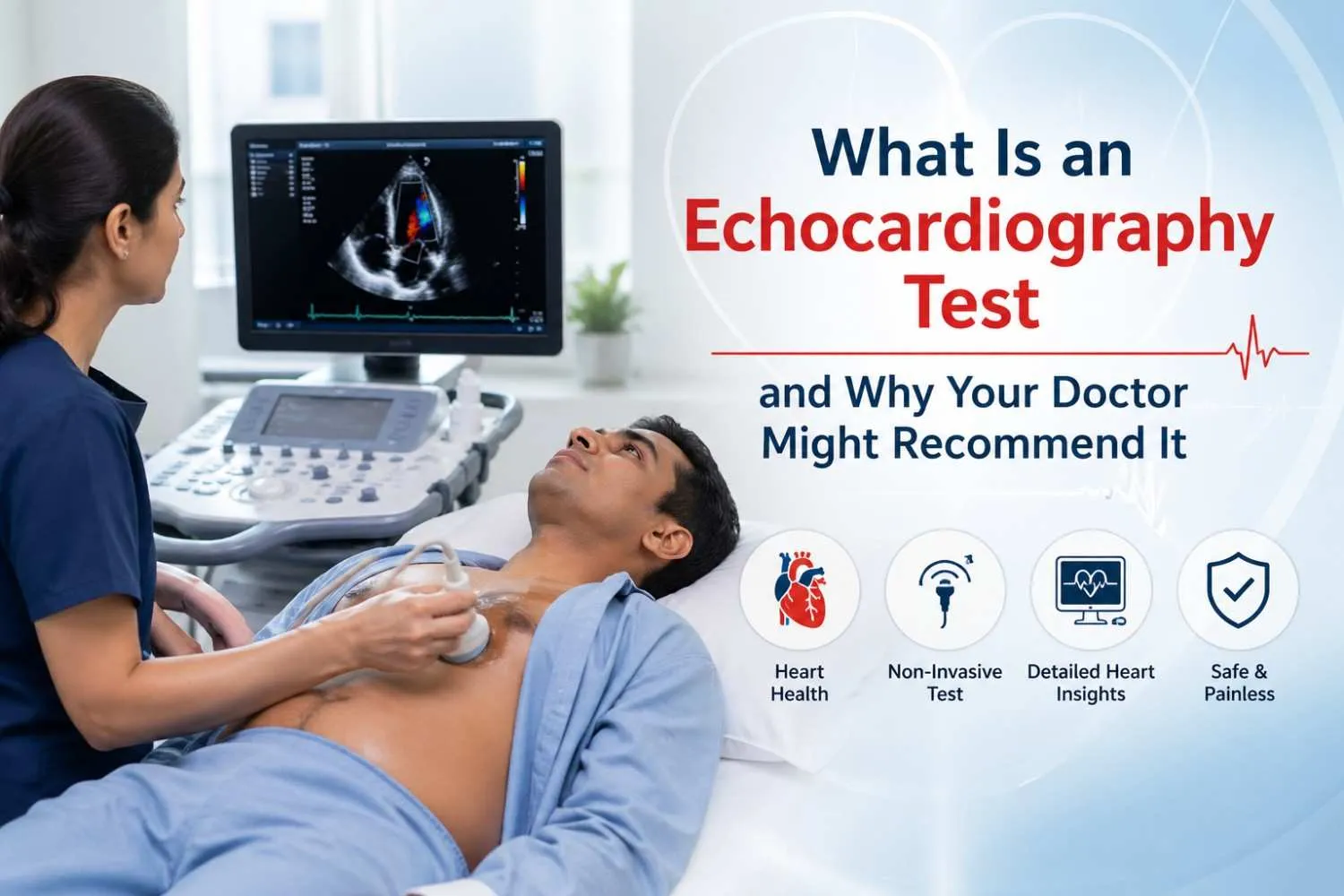
An echocardiogram, or echo test for the heart, is essentially an ultrasound of your heart. The same technology used to look at a baby during pregnancy is used here to look at your heart in real time. A small handheld probe is placed on your chest, and it sends out sound waves that bounce off the heart's structures and return as images on a screen.
These images show us the size and shape of your heart chambers, how well the heart muscle is pumping, whether your valves are opening and closing properly, and whether there is any fluid collecting around the heart. It is a live, moving picture of your heart doing its job, not just a snapshot.
There is no radiation involved. There are no needles. In the standard version of the test, which we call a transthoracic echo, you simply lie on a table, some gel is applied to your chest, and the probe does the rest. The echo test for the heart in Hyderabad at our clinic is done by trained cardiac sonographers and reviewed by me directly.
Here is something most people do not realise when they get referred for an echo: there is more than one kind. Which type I recommend depends entirely on what question I am trying to answer about your heart.
Table 1: Types of Echocardiogram and When Each Is Used
For most people walking into my clinic, the test they get is the transthoracic echo. You lie on a table, I put some gel on your chest, and that is about as involved as it gets. No needles, no sedation, no discomfort.
The transesophageal echo is a different story. It involves passing a thin probe into the food pipe, which does sound more intimidating than it actually is. Patients are given a mild sedative, the throat is numbed, and most people barely remember it. I use this when I need a much sharper view of the back of the heart, particularly the mitral valve, or when I am checking for clots before a cardioversion procedure.
The stress echo is one I find especially valuable because the heart is very good at hiding problems when it is just sitting quietly. Put it under load, and certain things become obvious that you would never catch at rest. So if someone tells me their chest tightens on a brisk walk but they feel fine sitting down, the stress echo is often exactly the right next step.
This is the part that genuinely impresses people when I explain it to them. The echocardiography test in Hyderabad can detect a wide range of conditions that would otherwise either be missed entirely or require much more invasive investigations to diagnose. Here is what we can see:
Table 2: Conditions an Echocardiogram Can Detect
Heart valve disease diagnosis is one of the most common reasons I order an echo. Whether it is aortic stenosis in an older patient, mitral valve prolapse in a younger person, or a post-rheumatic fever complication we see more frequently in India, the echo gives us a precise picture of how severe the problem is and whether it is progressing.
The ejection fraction is another key number we get from this test. This is the percentage of blood pumped out of the heart with each beat. A normal ejection fraction is between 55 and 70 percent. When it falls below that, it tells us the heart muscle is not working efficiently, and we need to understand why and start treatment.
I sometimes get asked by patients why I am ordering an echo when they have already had an ECG. It is a fair question. The ECG tells us about the electrical activity of the heart. The echo tells us about the physical structure and function. They are different tools that answer different questions, and often both are needed.
Table 3: Echo Versus Other Common Cardiac Investigations
As you can see from the table, the echocardiogram fills a gap that neither the ECG nor the stress test can fill on its own. It is the only routine cardiac test that directly visualises the heart muscle, the chambers, and the valves all at once without radiation or any invasive step in its standard form.
Every week in my clinic I see patients who are a little confused or anxious about being sent for an echo. They worry it means something serious has been found. I want to reassure you: being referred for an echo does not necessarily mean your doctor thinks something is wrong. It means your doctor wants to know for certain.
Here are the most common reasons a patient is referred for an echo:
• You have been found to have a heart murmur on examination
• You have been experiencing unexplained breathlessness or fatigue
• You have had a heart attack and we are assessing the damage
• You have been diagnosed with heart failure and we need to monitor your ejection fraction
• You have high blood pressure that has been uncontrolled for years and we want to check the impact on the heart
• You are about to have major surgery and we need a pre-operative cardiac assessment
• You have a family history of cardiomyopathy or sudden cardiac death and we want a baseline scan
• You have atrial fibrillation and we need to check for clots or structural causes
Table 4: Who Should Have an Echocardiogram and How Often
One of the questions I hear often is about heart ultrasound cost in Hyderabad. I understand this is a real concern for many families. The cost of an echocardiogram varies depending on the type of echo, the facility, and whether additional Doppler studies are included. Let me be honest with you about costs, because I know it is one of the first things people think about but rarely feel comfortable asking.
A standard transthoracic echo is not an expensive test relative to what it tells us. When you consider that it can detect a serious valve problem, confirm heart failure, or rule out a structural abnormality in under 30 minutes, the value it provides is genuinely hard to match. That said, I understand that any out-of-pocket medical expense feels significant, and I never want cost to be the reason someone delays a test they actually need.
At Germanten Hospital, we have made it a point to keep cardiac investigations accessible. If you have been referred for an echo and cost is a concern, please just say so when you call or come in. Our team will work through the options with you. There is no reason to put off a test or sit at home worrying when a straightforward conversation can sort it out.
And if location matters to you, we are right here in Attapur. Our cardiac unit covers the full range of echo modalities: standard transthoracic echo for routine assessments, Doppler studies for blood flow analysis, stress echo for exertion-related symptoms, and transesophageal echo when a closer look is needed. You do not have to travel across the city for a well-equipped facility. We have what you need, close to where you are.
Practical note: For most standard echocardiograms, you do not need to fast or make any special preparation. Wear comfortable clothing that can be easily adjusted around the chest. The test takes between 20 and 45 minutes depending on the complexity. You can drive yourself home afterwards and resume normal activity immediately.
Once the test is done, the images are reviewed and a formal report is written. In our clinic, I sit with patients after the echo and walk them through the findings in plain language. Not in medical jargon, not in numbers without context, but in a way that makes sense.
If the echo is normal, that is genuinely reassuring news and we document it as a baseline. If it shows something that needs attention, we talk about what that means, what the next steps are, and what the realistic timeline looks like. A finding on an echo is not a sentence. For most conditions, there is a clear and effective management pathway.
For conditions like heart valve disease, the echo guides us on timing. Many patients with mild to moderate valve disease live completely normal lives for years before any intervention is needed. But we need the echo to track the progression and catch the right window for treatment when it comes.
Hyderabad has one of the highest rates of urban cardiovascular disease in India. The combination of high diabetes prevalence, uncontrolled hypertension, sedentary work culture, and dietary patterns puts a significant portion of the adult population at risk for conditions that the echocardiography test in Hyderabad can detect early.
Rheumatic heart disease, which damages the mitral and aortic valves as a late complication of streptococcal throat infections, remains more common in India than in high-income countries. Many patients have had rheumatic fever in childhood and do not know it. Their first clue that something is wrong may be a murmur picked up during a routine examination years later.
Similarly, hypertensive heart disease is something I see frequently in patients in their 40s and 50s who have had raised blood pressure for a decade but never had their heart properly assessed. The echo often reveals left ventricular hypertrophy, a thickening of the heart wall in response to the pressure load, which is an independent risk factor for heart failure and arrhythmia.
Getting an echo test for the heart in Hyderabad done proactively, when you have known risk factors, is one of the smartest investments you can make in your long-term cardiac health.
The echocardiogram is not a scary test. It is not complicated. And it is not something you should delay if your doctor has recommended it. It is simply the best way we currently have to look inside the heart and understand what is happening, without putting you through anything invasive or uncomfortable.
Whether you need a routine check because of a murmur, you are managing a known cardiac condition, or you want a baseline assessment because of your family history or risk factors, the echocardiography test in Hyderabad gives us the clinical clarity to make better decisions for your health.
If you have been referred for an echo or are wondering whether you should have one, come in. We will talk through it, do the test, and explain exactly what we find. That is what I am here for.
1. American Society of Echocardiography. Guidelines and Standards. https://www.asecho.org/guidelines-and-standards/
2. Mayo Clinic. Echocardiogram: What You Can Expect. Updated 2024. https://www.mayoclinic.org/tests-procedures/echocardiogram/about/pac-20393856
3. American Heart Association. Echocardiogram (Echo). https://www.heart.org/en/health-topics/heart-failure/diagnosing-heart-failure/echocardiogram-echo
4. Nishimura RA, et al. 2014 AHA/ACC Guideline for the Management of Patients with Valvular Heart Disease. Journal of the American College of Cardiology. 2014;63(22):e57-e185. https://www.ahajournals.org/doi/10.1161/CIR.0000000000000923
5. Prabhakaran D, Jeemon P, Roy A. Cardiovascular Diseases in India: Current Epidemiology and Future Directions. Circulation. AHA Journals. https://www.ahajournals.org/doi/10.1161/circulationaha.114.008729
6. Lancet Southeast Asia. The Burgeoning Cardiovascular Disease Epidemic in Indians. 2023. https://www.thelancet.com/journals/lansea/article/PIIS2772-3682(23)00016-1/fulltext
7. NHS UK. Echocardiogram Overview. 2023. https://www.nhs.uk/conditions/echocardiogram/