10 Massages and Stretches for a Frozen Shoulder
June 15, 2023
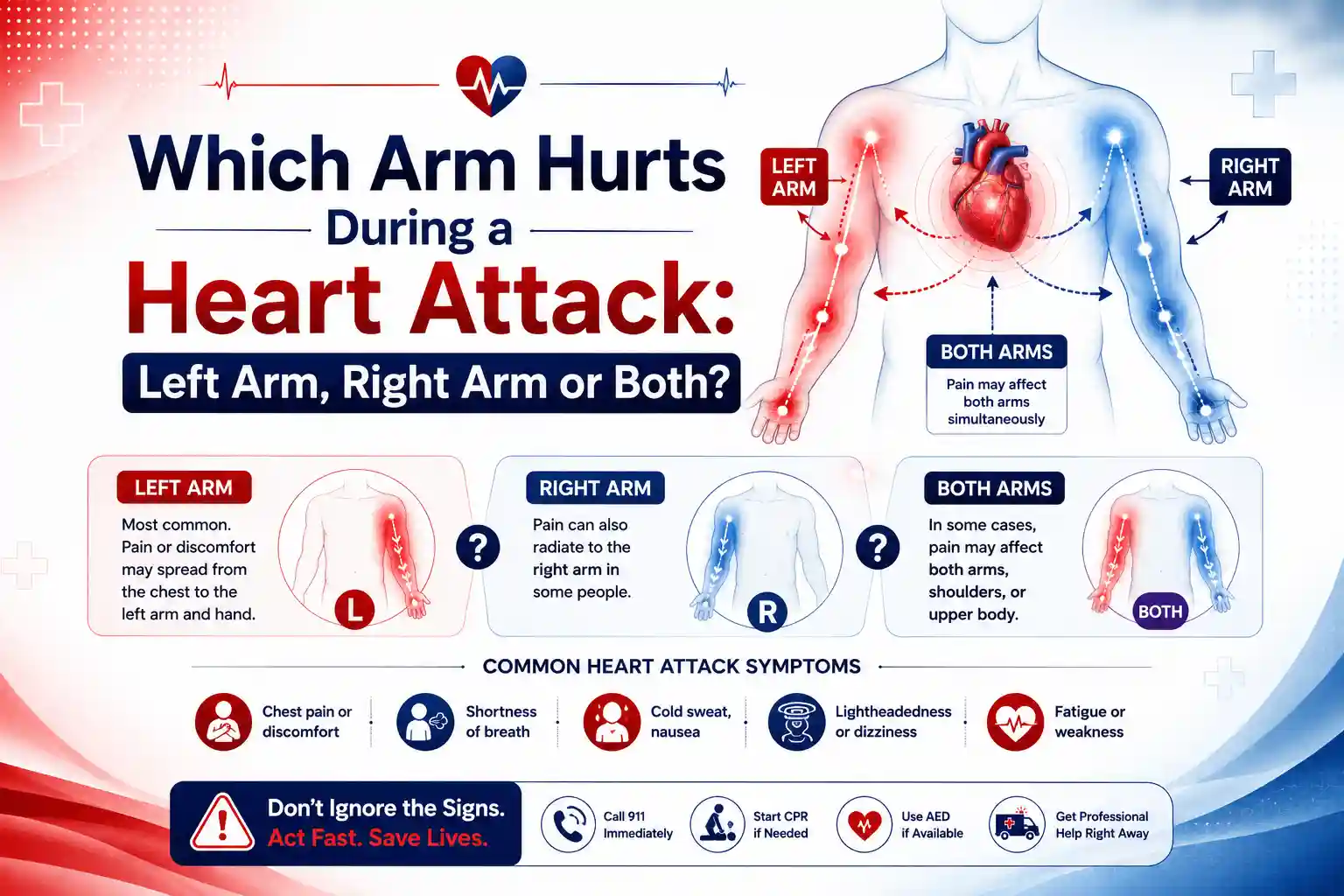
Most people expect a heart attack to announce itself with pain down the left arm. That expectation is not wrong, but it is incomplete. Heart attack pain can appear in the right arm, both arms, or not in the arms at all, and relying only on the left arm rule can cause people to miss or dismiss a real emergency.
Understanding which arm hurts during a heart attack, and why, starts with understanding how the heart's pain signals actually travel through the body.
Heart attack pain in the arm is what doctors call referred pain. The heart and the skin and muscles of the upper chest and arm share overlapping nerve pathways as they enter the spinal cord. When the heart muscle is short of oxygen, the brain sometimes misreads these overlapping signals as pain coming from the arm rather than from the heart itself.
This is the same general mechanism that can make a heart attack feel like jaw, neck, or upper back pain instead of chest pain.
This overlap is strongest on the left side, since the heart sits slightly left of centre in the chest, which is part of why left arm pain became the well-known warning sign in the first place. But the same nerve pathways extend more widely than most people realise, reaching the right arm, both shoulders, the neck, and the jaw.
That wider reach is exactly why a heart attack can present in so many different ways from one person to the next.
Left arm pain during a heart attack is typically described as a dull ache, heaviness, or pressure rather than a sharp, localised pain.
According to Ochsner Health, this discomfort often extends from the chest or shoulder down the arm and does not improve with resting the arm or changing its position, which helps distinguish it from a muscle strain or joint problem.
Left arm pain gets most of the attention, but it is not the only pattern. According to research summarised by ScienceInsights, right arm or shoulder pain appears in roughly 15 to 23 percent of confirmed heart attacks, and pain affecting both arms at once can be an even stronger indicator of a serious blockage than left arm pain alone.
Because most public awareness focuses only on the left side, right arm or bilateral arm pain is more likely to be dismissed or misunderstood as something else.
Here is how the different patterns compare:
| Side | How Common | What It Often Feels Like |
|---|---|---|
| Left arm | Most common pattern, especially in men | Dull ache, heaviness, or pressure from the chest to the arm |
| Right arm | Roughly 15 to 23 percent of confirmed heart attacks | Similar dull ache or heaviness, often underrecognised |
| Both arms | Less common, but a strong warning sign | Heaviness or pressure in both arms at once |
| No arm pain | Common in women, older adults, and people with diabetes | Jaw, neck, back, or stomach discomfort, or fatigue alone |
Not every ache in the arm is cardiac, and most are not. Muscle strain from exercise or lifting, a pinched nerve in the neck, tendonitis, or simply sleeping in an awkward position are all far more common causes of arm pain than a heart attack.
These causes typically stay localised to the arm or shoulder, often worsen with specific movements or pressing on the area, and do not come with chest pressure, breathlessness, sweating, or nausea.
The distinguishing feature is context: isolated arm pain that changes with movement is usually musculoskeletal, while arm pain that arrives alongside other symptoms and does not respond to rest deserves urgent attention.
Cardiac arm pain, according to Norton Healthcare, does not usually get worse when you press on the area or move the arm into a different position, unlike a pulled muscle or joint injury.
It is also rarely an isolated symptom. Chest pressure, breathlessness, sweating, nausea, or lightheadedness alongside arm discomfort is a strong signal that the cause may be cardiac rather than musculoskeletal.
Referred pain from a heart attack is not limited to the arms. According to Healthline, it can also appear in the jaw, neck, upper back, or upper abdomen, sometimes without any chest pain at all.
This pattern is more common in women and in people with diabetes, both of which are groups that more often experience what doctors call atypical heart attack symptoms.
Unexplained arm pain that comes on suddenly, does not respond to rest or position changes, and appears alongside chest pressure, breathlessness, sweating, or nausea should never be dismissed as a muscle strain.
Getting prompt evaluation from a heart specialist in Hyderabad can confirm or rule out a cardiac cause quickly, using an ECG and blood tests to check for heart muscle damage.
Arm pain during a heart attack is real, but it is more complicated than the classic left arm warning most people know. Right arm pain, pain in both arms, and pain in the jaw, neck, or back can all be signs of the same underlying emergency.
Knowing the fuller picture means fewer missed warning signs.
If you have experienced unexplained arm, shoulder, or chest pain and want a thorough cardiac evaluation, book a cardiology appointment with Germanten Hospitals in Attapur, Hyderabad.
No. Some heart attacks cause no arm pain at all, particularly in women, older adults, and people with diabetes, who more often experience atypical symptoms like fatigue, nausea, or jaw pain instead.
The heart sits slightly to the left of the chest, and its nerve pathways overlap more heavily with those supplying the left arm, which is why referred pain is more commonly felt on that side.
Yes. Right arm pain, and pain in both arms together, can be just as significant a warning sign as left arm pain, even though it receives far less public attention.
Cardiac arm pain typically feels like a dull ache, heaviness, or pressure, does not worsen with movement or pressing on the area, and is usually accompanied by other symptoms such as breathlessness or chest discomfort.
Yes, though it is uncommon. This is sometimes called an atypical or silent heart attack and is more frequently seen in women, older adults, and people with diabetes.
If the pain is severe, persistent, or comes with chest pressure, breathlessness, sweating, or nausea, seek emergency medical evaluation immediately rather than waiting to see if it passes.