10 Massages and Stretches for a Frozen Shoulder
June 15, 2023
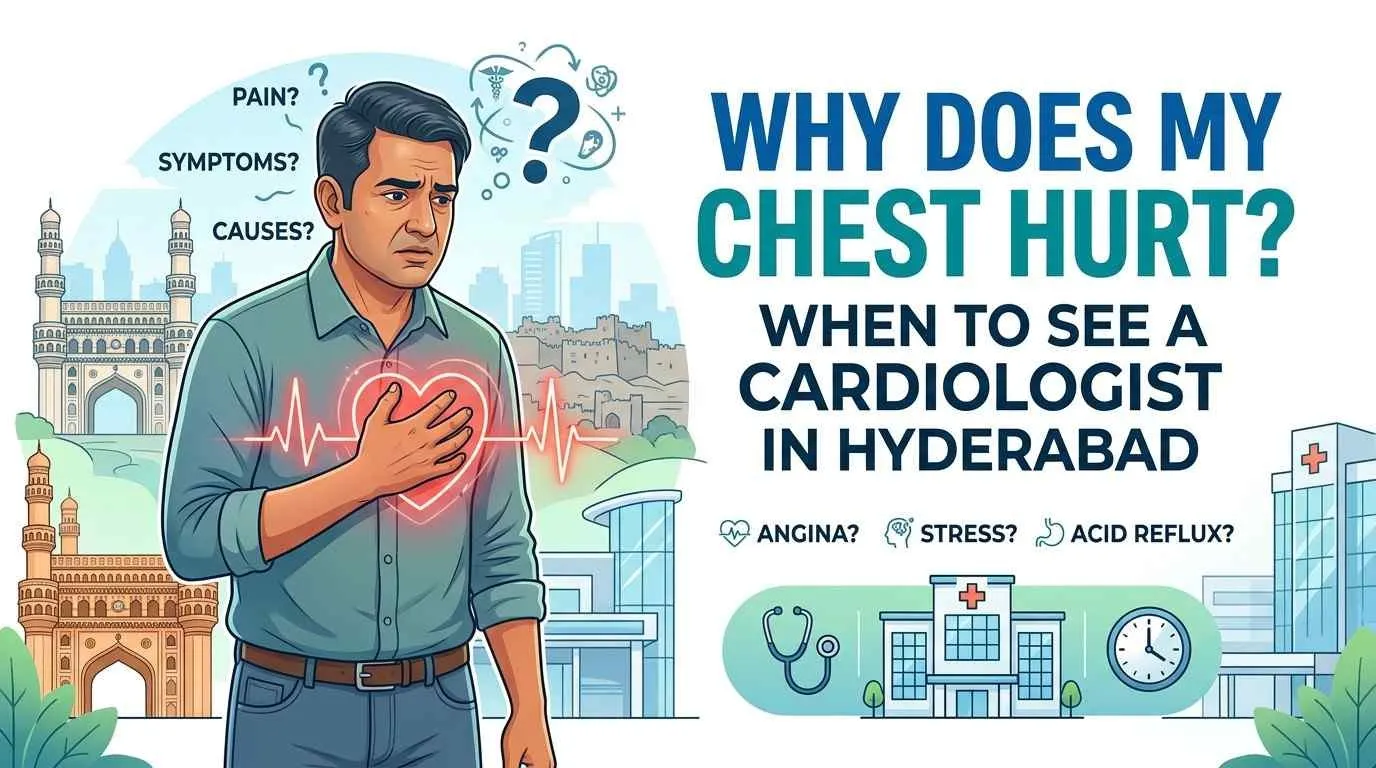
Let me be straight with you: chest pain scares people. It should. But in my years of practice as an interventional cardiologist in Hyderabad, I can tell you that it does not always mean your heart is in trouble. I have seen patients rush in convinced they were having a heart attack only to find out it was acidity. And I have seen the opposite too: people who brushed off their discomfort for weeks, only to discover a serious coronary blockage.
That is exactly why understanding chest pain causes in Hyderabad matters so much. The city’s fast-paced lifestyle, late-night eating habits, sedentary IT jobs, and high stress levels have made heart disease more common and younger in onset than ever before. So let me walk you through what I tell my patients every day: what chest pain usually is, what it sometimes means, and when you really should pick up the phone and call a cardiologist.
I know it might feel counterintuitive coming from a cardiologist, but the truth is: most chest pain I see in the clinic is not directly from the heart. Your chest is a pretty crowded space as your lungs, food pipe, ribs, stomach, and nerves all share real estate there. Any one of them can cause discomfort that feels alarming.
Here are the non-cardiac culprits I see most often:
Table 1: Common Non-Cardiac Causes of Chest Pain
The important thing to note here: even if one of these non-cardiac causes seems to fit your symptoms perfectly, please do not diagnose yourself and move on. In my experience, patients with acid reflux can also have underlying heart disease. The two are not mutually exclusive. When in doubt, get checked.
This is the chest pain vs. heart attack difference that every person should understand not just patients, but their families too. A heart attack happens when one of the arteries supplying blood to your heart gets blocked. Without blood flow, heart muscle begins to die. The longer the blockage, the greater the damage. That is why we say: time is muscle.
Classic heart attack symptoms look like this:
• A heavy squeezing or crushing pressure in the middle of your chest, not a sharp stab, but a deep, persistent weight
• Pain that travels down your left arm, up into your jaw, across your back, or into your neck
• Breaking into a cold sweat for no obvious reason
• Feeling short of breath even while sitting still
• Sudden dizziness or feeling like you might pass out
• Nausea or vomiting alongside chest discomfort
• An unusual sense of dread or doom that is hard to explain
A quick note from the doctor - If you or someone with you has any combination of the above symptoms, call emergency services immediately or head straight to the nearest hospital. Please do not drive yourself. In a heart attack, every minute without treatment means more heart muscle lost. Speed genuinely saves lives.
Now, non-cardiac chest pain tends to behave differently. It is usually sharp rather than heavy, gets worse when you press on the chest, changes when you shift position or take a deep breath, or appears right after eating. But these patterns are not reliable rules. Women, people with diabetes, and older adults very commonly experience heart attacks without any chest pain at all. They might just feel unusually tired, nauseous, or breathless. This is why no symptom should be dismissed simply because it does not fit the textbook picture.
I want to be honest: Hyderabad is not doing great when it comes to heart health. Over my years of practice, I have watched the average age of a first heart attack drop significantly. I see 35-year-old software engineers, 42-year-old business owners, and 28-year-old women presenting with serious coronary artery disease, people who had no warning because they felt too young to worry.
The reasons are fairly well understood. Here is a snapshot of the biggest chest pain causes in Hyderabad and what drives them:
Table 2: Cardiac Risk Factors - Hyderabad Urban Profile
The pattern I see repeatedly: a patient comes in with chest heaviness they’ve attributed to acidity or tiredness for the past three months. We do an ECG, run a stress test, and find significant blockages. This is not rare. Early diagnosis and the right chest tightness treatment in Hyderabad genuinely changes outcomes and it can prevent a heart attack before it happens.
People ask me this all the time, and my answer is simpler than most expect: if chest pain is making you wonder whether you need a cardiologist, that thought alone is reason enough to come in. But more specifically, knowing when to visit a heart doctor becomes critical when:
• Your chest pain or tightness comes on during a walk, a workout, or any physical activity and eases up when you stop
• You’ve been feeling a vague heaviness or pressure in your chest on and off for more than a week
• You notice your heart racing, skipping beats, or fluttering, especially with dizziness
• You get breathless doing things that never used to wind you
• Your ankles are swelling, especially alongside unexplained fatigue
• There’s a family history of heart attacks before 55 or sudden cardiac deaths
• You have diabetes, high blood pressure, or high cholesterol and have never had your heart properly screened
Good to know - A complete first-time cardiac evaluation history that is ECG, echocardiogram, and stress test where needed typically just 2 to 3 hours. It gives you real answers. As a cardiologist in Attapur, I would far rather reassure you with a clean report than have you dismiss symptoms that deserved attention.
I understand that walking into a cardiology clinic can feel a bit daunting. Most of my patients arrive with a mix of worry and uncertainty. The first thing I want them to know is: a consultation is just a conversation, backed by a few focused tests.
Here is what a typical first visit looks like at our clinic:
Table 3: What Happens During a Cardiology Consultation
For most patients, the management pathway for chest tightness treatment in Hyderabad starts with lifestyle changes and medication. We look at diet, activity, sleep, and stress and build a plan that is realistic for your life, not just textbook advice. Also, we discuss options including angioplasty or bypass surgery calmly, clearly, and without pressure for cases like blockages. Our goal is that you understand your condition and feel in control of what comes next.
Note: This table is a general guide, not a diagnostic tool. Any chest pain that concerns you deserves professional evaluation.
Chest pain should never be something you just push through and hope goes away. The spectrum of chest pain caused in Hyderabad is wide from something as simple as a strained muscle to a blocked coronary artery and only a proper evaluation can tell you which one applies to you. Understanding the chest pain vs. heart attack difference, knowing your risk factors, and recognising when to visit a heart doctor could genuinely be the most important health decision you make this year.
As a cardiologist in Attapur, I see the full range patients who caught something early and avoided a crisis, and patients who waited too long. I would like every person reading this to be in the first group. If something feels off, trust that instinct. Come in. Let us figure it out together.
1. Mayo Clinic. Chest Pain - Symptoms and Causes. Updated December 2024.
2. Mayo Clinic. Heart Attack - Symptoms and Causes.
3. American Heart Association. Warning Signs of a Heart Attack.
4. American Heart Association. Heart Attack Symptoms in Women.
5. Gulati M, et al. 2021 AHA/ACC/ASE/CHEST/SAEM/SCCT/SCMR Guideline for the Evaluation and Diagnosis of Chest Pain. Circulation. 2021;144:e368–e454.
6. Prabhakaran D, Jeemon P, Roy A. Cardiovascular Diseases in India: Current Epidemiology and Future Directions. AHA Journals / Circulation.
7. The Lancet Southeast Asia. The Burgeoning Cardiovascular Disease Epidemic in Indians. 2023.