10 Massages and Stretches for a Frozen Shoulder
June 15, 2023

Rahul was a 47-year-old software engineer from Hyderabad. He first noticed a dull ache in his right groin after a long walk in late 2023. He chalked it up to sitting at his desk for too many hours. He stretched, took an ibuprofen, and kept going.
Six months later, he was avoiding the stairs at work. He started parking closer to the entrance. His evening walks stopped completely. When he finally saw a doctor, the diagnosis was Stage II Avascular Necrosis, a condition where the bone of the hip joint is literally dying from loss of blood supply. Stage III was just around the corner.
His case was not rare. In India, hundreds of thousands of people walk around with hip pain every day and do nothing, assuming it will pass. But hip pain when walking is almost never random. It is your body sending a very specific signal. And the location of that signal tells a completely different story each time.
What is hip pain when walking? It is any discomfort, ache, or sharp sensation felt in or around the hip joint during movement or weight-bearing activity, coming from bones, cartilage, tendons, muscles, or nerves.
According to research, around 10% of the general population lives with chronic hip pain. In India, AVN-related hip conditions are projected to affect an estimated 2 lakh people in 2024, with that number surging further due to widespread steroid use during the COVID-19 pandemic.
This article breaks down the 7 most common reasons your hip hurts when you walk, including causes that most websites completely skip. We also show you how to read your pain by location so you can have a smarter conversation with your orthopedic surgeon in Hyderabad or wherever you are.
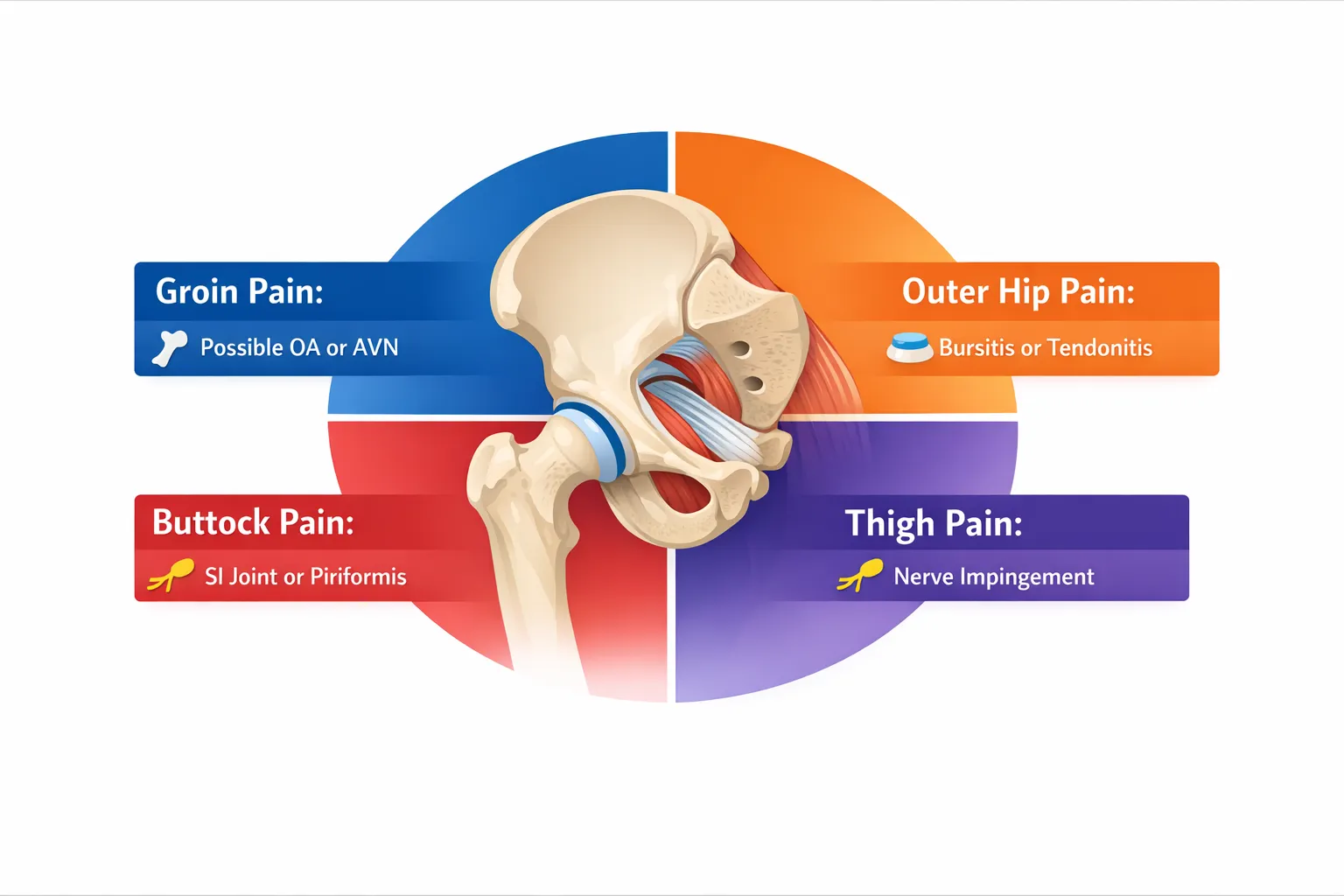
Most articles skip this step entirely. It is one of the most useful things you can know before your doctor visit. Your hip can send pain from six different anatomical structures, and where you feel that pain is your first clue about what is wrong.
• Front of hip or groin: Almost always points to a problem inside the joint, such as osteoarthritis, labral tear, or avascular necrosis.
• Outer hip or side: Pain over the bony bump at the top of your thigh is typically a tendon or bursa problem, known as Greater Trochanteric Pain Syndrome.
• Buttock or back of hip: This pain often originates outside the hip joint itself, from the sciatic nerve, piriformis muscle, or sacroiliac joint.
• Radiating down the thigh toward the knee: This suggests referred pain and can be a warning sign of avascular necrosis or nerve compression.
According to ScienceInsights, the location of the pain is the single most useful clue to what structure is involved and how to treat it.
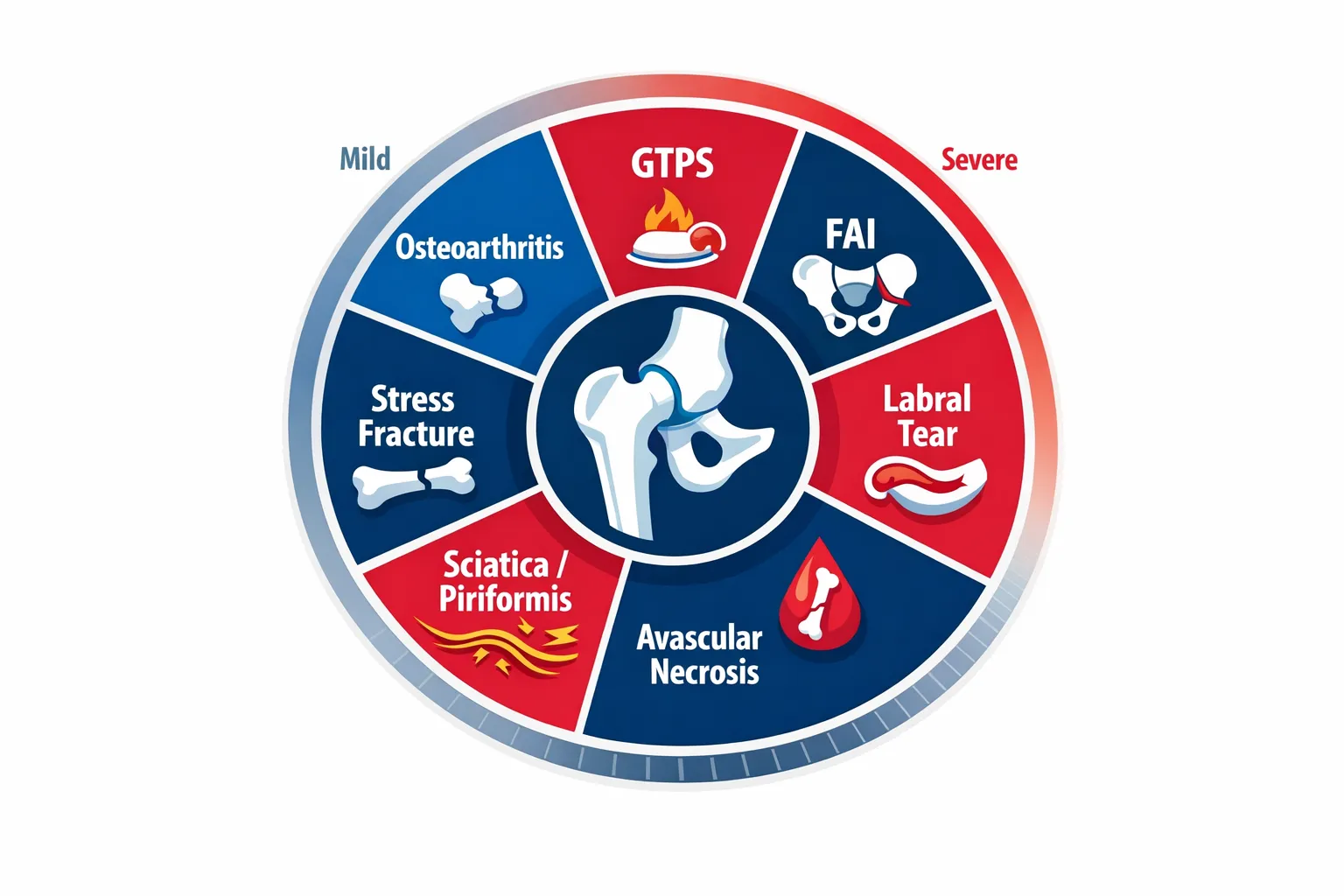
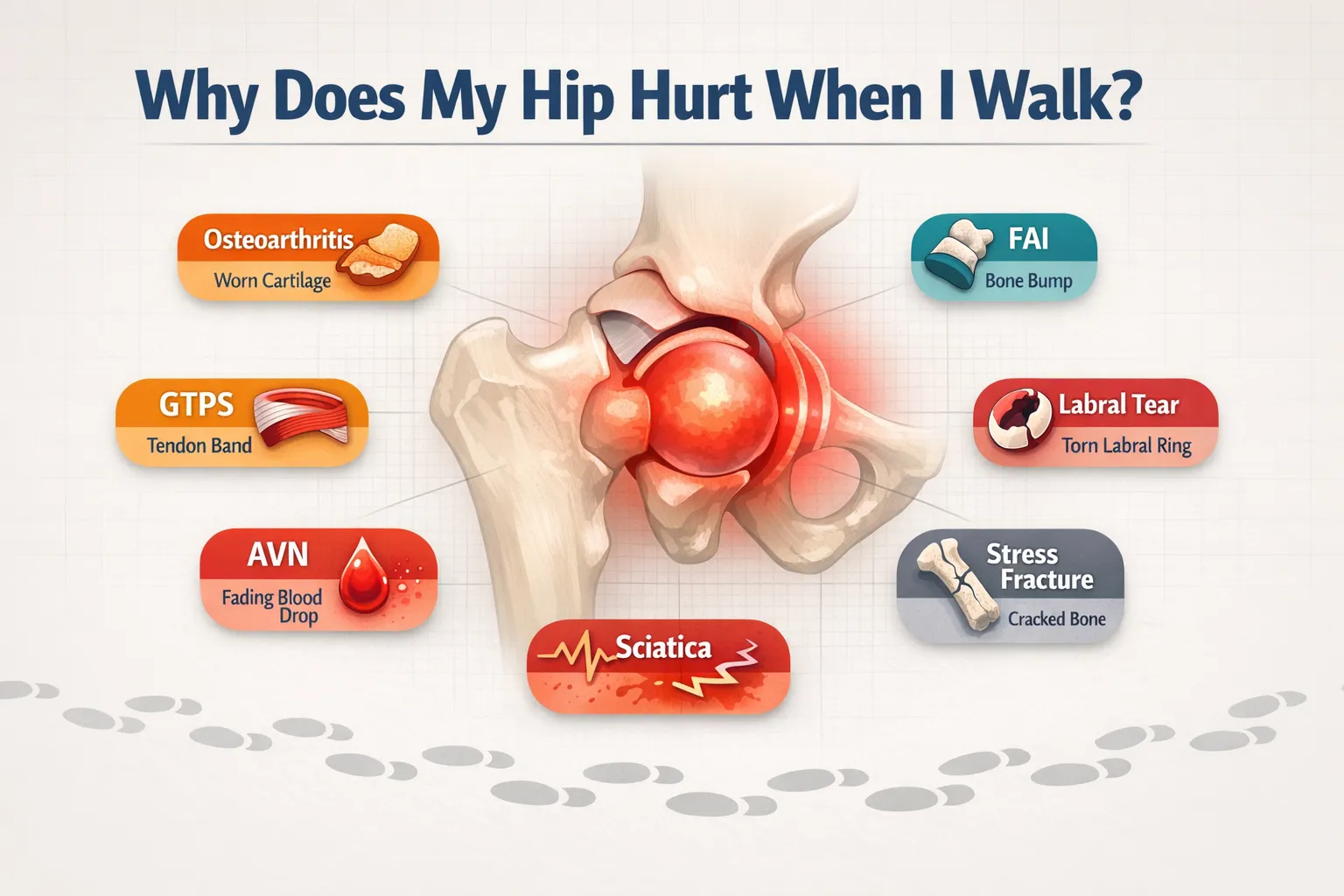
Osteoarthritis is the leading cause of hip pain in adults over 50. It happens when the cartilage cushioning your hip joint wears away over time, leaving bone rubbing against bone. The joint becomes inflamed, stiff, and painful.
What it feels like: A dull, deep ache in the front of your hip or groin. Many people notice stiffness after sitting that eases in the first few minutes of walking, but the ache returns after a long walk or standing session.
What most websites do not tell you: That brief improvement after the first few steps is actually a classic early OA pattern called "start-up pain." Many patients think they are fine because the pain goes away. In reality, the cartilage is already thinning.
A 2025 study published in PMC estimated the global prevalence of hip osteoarthritis at 59.5 million cases in 2024, with incidence rising steadily due to aging populations and obesity. Even in younger adults, high BMI, family history, and prior hip injury can accelerate cartilage breakdown.
Here is the surprising truth about outer hip pain: most people are being told they have bursitis when the real cause is a damaged tendon.
Greater Trochanteric Pain Syndrome covers pain on the outer side of the hip, over the bony bump at the top of your thigh. For years, this was blamed entirely on bursa inflammation. Recent research from the American Academy of Family Physicians (AAFP) confirms that in the majority of cases, the primary problem is gluteal tendinopathy, not bursitis. In fact, only about 10% of lateral hip pain cases are truly driven by bursitis.
What it feels like: Pain on the outside of your hip that worsens with stair climbing, long walking, sleeping on the affected side, or sitting with legs crossed.
Who gets it most: Women between 40 and 60, with no specific injury to point to. The AAFP notes that patients may develop a Trendelenburg gait, where the pelvis drops on one side while walking, a visible warning sign.
Why does this matter? If your outer hip pain is a tendon problem being treated as bursitis, cortisone injections alone will not fix it. Targeted physiotherapy for the gluteal muscles is a critical part of proper recovery.
Book an appointment with our orthopedic specialists in Hyderabad for a precise diagnosis and targeted treatment plan.
Think hip pain only happens to older people? FAI is proving that wrong.
FAI occurs when the bones of the hip joint are abnormally shaped, so instead of gliding smoothly, they pinch and rub against each other during movement. Over time, this damages the cartilage and the labrum, the soft tissue ring around the hip socket.
What most people miss: A PubMed meta-analysis found that FAI should be suspected in 47 to 74% of non-arthritic patients with hip pain. It is one of the most underdiagnosed conditions in young adults.
Special risk for young athletes and desk workers: Research from NCBI StatPearls shows that adolescents in high-intensity sports are 10 times more likely to develop cam-type FAI compared to non-athletes. However, desk workers who sit for long hours with the hips bent also repeatedly stress the joint in ways that trigger symptoms.
What it feels like: A deep groin ache after sitting, cycling, or stair climbing. Many people describe a catching or clicking sensation in the hip during certain movements.
If left untreated, FAI is a well-established pathway to labral tears and early-onset osteoarthritis.
The labrum is a ring of tough cartilage that lines the rim of your hip socket. It acts like a rubber seal, keeping the joint stable and lubricated. When it tears, that stability is lost.
Why it gets missed so often: Labral tears do not show up on regular X-rays. You need an MRI or MR arthrogram for a proper diagnosis. Many patients spend months being treated for muscle strain before anyone finds the real cause.
What it feels like: A deep clicking, locking, or catching sensation in the hip during walking, especially when turning or changing direction. Some people feel a sharp catch in the groin. Others describe a persistent stiffness that never fully resolves after rest.
According to ScienceInsights, labral tears can result from a single trauma, such as a fall or sports injury, but they also develop gradually from repetitive motion or structural issues like FAI that apply abnormal pressure to the rim over time.
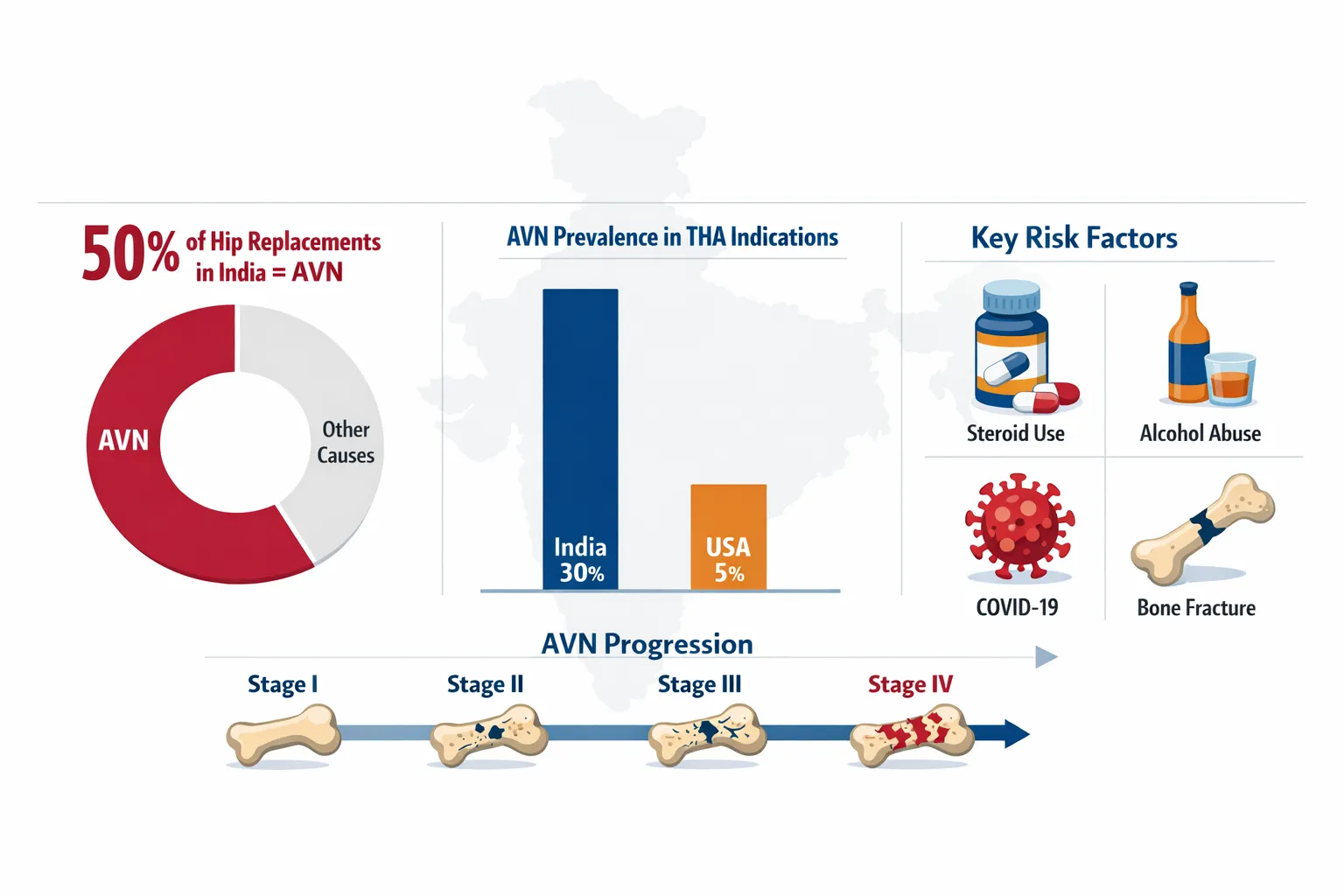
This is the cause that most competitor websites skip entirely. For readers in India, it deserves a prominent spotlight.
Avascular Necrosis, also called osteonecrosis, happens when the blood supply to the femoral head (the ball of the hip joint) is cut off. Without blood, bone tissue begins to die. As the disease progresses, the ball collapses and the entire joint is destroyed.
The India-specific reality: According to the Indian Society of Hip and Knee Surgeons Registry, as high as 50% of all total hip replacements performed in India are due to AVN. Compare that to the US, where osteoarthritis is the leading cause. AVN cases in India are projected to reach 2 lakh in 2024, and the COVID-19 pandemic has pushed that number further due to widespread high-dose steroid treatment.
A study published in Cureus (2024) found the prevalence of AVN in India to be 10.8% in males and 1.3% in females between ages 26 and 40, making it a disease that strikes in the prime of life.
Key risk factors in the Indian context:
• Prolonged steroid use, including post-COVID treatment
• Heavy alcohol consumption
• Sickle cell disease
• Hip dislocation or fracture from trauma
What it feels like: Groin and front-of-hip pain that worsens with weight-bearing activities like walking or climbing stairs, but partially eases at rest. As the disease advances, pain continues even at night and the hip becomes progressively stiff.
The critical window: AVN caught in Stage I or Stage II can often be managed with core decompression or advanced joint-preservation therapies. Stage III or IV almost always requires total hip replacement. Early diagnosis is everything.
Learn about our hip treatment and replacement options at Germanten Hospital, rated among the best orthopedic hospitals in Hyderabad.
What most people do not realize is that not all "hip pain" comes from the hip joint at all. This is one of the most important and least-discussed points in hip care.
The sciatic nerve runs from your lower back, through the piriformis muscle in the buttock, and down the back of your leg. When this nerve gets compressed or irritated, the pain it creates can feel exactly like a hip problem.
What it feels like: Pain or burning in the buttock and back of the hip, sometimes shooting down the thigh toward the knee. It typically worsens with fast walking or going uphill.
The under-discussed trigger for Indian professionals: Sitting on a thick wallet or phone in your back pocket, or spending long hours on a bike or in a car, directly compresses and irritates the piriformis muscle. This is surprisingly common among urban commuters in Hyderabad and other Indian cities who travel long distances by two-wheeler or car. The piriformis tightens, the sciatic nerve gets squeezed, and the result is classic hip-area pain that is actually coming from your buttock and lower back.
The AAFP confirms that lumbar spinal issues can present entirely as posterior hip and buttock pain, making it easy to confuse a back problem with a hip problem when imaging is not used.
This cause is especially common in post-menopausal women and is frequently missed because initial X-rays can appear completely normal.
A stress fracture in the femoral neck (the narrow part of the thigh bone just below the hip joint) builds up silently from repetitive loading, not from a single fall or accident. The bone is simply too weak to handle the daily demands being placed on it.
The red flag no one warns you about: According to Mayo Clinic (updated 2025), in people with very weak bones, a fracture can occur simply by standing and twisting, with no fall involved. Hip fractures also occur in women about three times more often than in men.
Who is most at risk:
• Post-menopausal women
• Anyone on long-term corticosteroids
• People with low vitamin D and calcium intake
• Runners who have rapidly increased their training load
• Women with very low body weight or eating disorders
What it feels like: A dull, nagging ache in the front of the hip or groin that gets progressively worse with walking and does not ease with rest. Night pain that wakes you up is a warning sign that the fracture may be advancing.
Most hip pain is manageable with early treatment. But some signals mean you need to see an orthopedic specialist right away. Contact the best doctors for orthopedic care in Hyderabad or in your city immediately if you notice any of the following:
• Sudden hip pain after a fall or impact — possible fracture
• Groin pain with fever — possible septic arthritis, a medical emergency
•
Pain that does not improve after two weeks of rest
• Hip or groin pain in a child or teenager — possible slipped capital femoral epiphysis, needs urgent assessment
• Any hip pain after prolonged steroid use — AVN risk window
• Night pain that wakes you from sleep
• Hip that feels like it might give way under your weight
Hip pain when walking is not just an ache you should push through. It is a specific signal from a specific structure inside or around your hip joint. The 7 causes covered here range from common cartilage wear to bone-threatening AVN, and each one responds very differently to treatment.
Here are the key takeaways from this article:
• The location of your hip pain is your most important diagnostic clue before any scan.
• Outer hip pain is mostly a tendon problem, not bursitis, and needs different treatment.
• FAI is heavily underdiagnosed in young professionals, athletes, and desk workers.
• In India, AVN is a major cause of hip destruction in people as young as 26, especially after COVID-19-related steroid use.
• Not all hip pain comes from the hip. Sciatica and piriformis syndrome mimic it perfectly.
• Stress fractures are silent, dangerous, and three times more common in women.
• Early diagnosis is the single biggest factor in how well and how fully you recover.
Do not let hip pain become hip damage. If your pain has lasted more than two weeks, affects your daily walking, wakes you up at night, or comes with any of the red flags above, it is time to act.
and consult with the best orthopedic doctors in Hyderabad. We use German precision diagnostics to find the exact cause of your pain before it turns into something irreversible.