10 Massages and Stretches for a Frozen Shoulder
June 15, 2023
A man in his forties collapses at his desk in Hyderabad. Is it a heart attack, or is it cardiac arrest? Most people watching cannot tell the difference, and in a real emergency, that confusion costs minutes that matter.
Cardiac arrest vs heart attack is one of the most searched health questions in India today, and for good reason. The two terms sound alike, but they describe two different medical events with different causes, different symptoms, and different emergency responses. A heart attack is a blood flow problem. Cardiac arrest is an electrical problem that stops the heart from beating. One can lead to the other, and both need immediate medical attention, but knowing which one you are dealing with changes what you should do in the first few minutes.
This distinction matters even more in India, where heart disease strikes earlier than in most parts of the world. According to the Indian Heart Association, 50 percent of heart attacks in Indian men happen before age 50, and 25 percent happen before 40. Recognizing the difference between cardiac arrest and heart attack, and knowing what to do in the first few minutes, can decide whether someone survives.
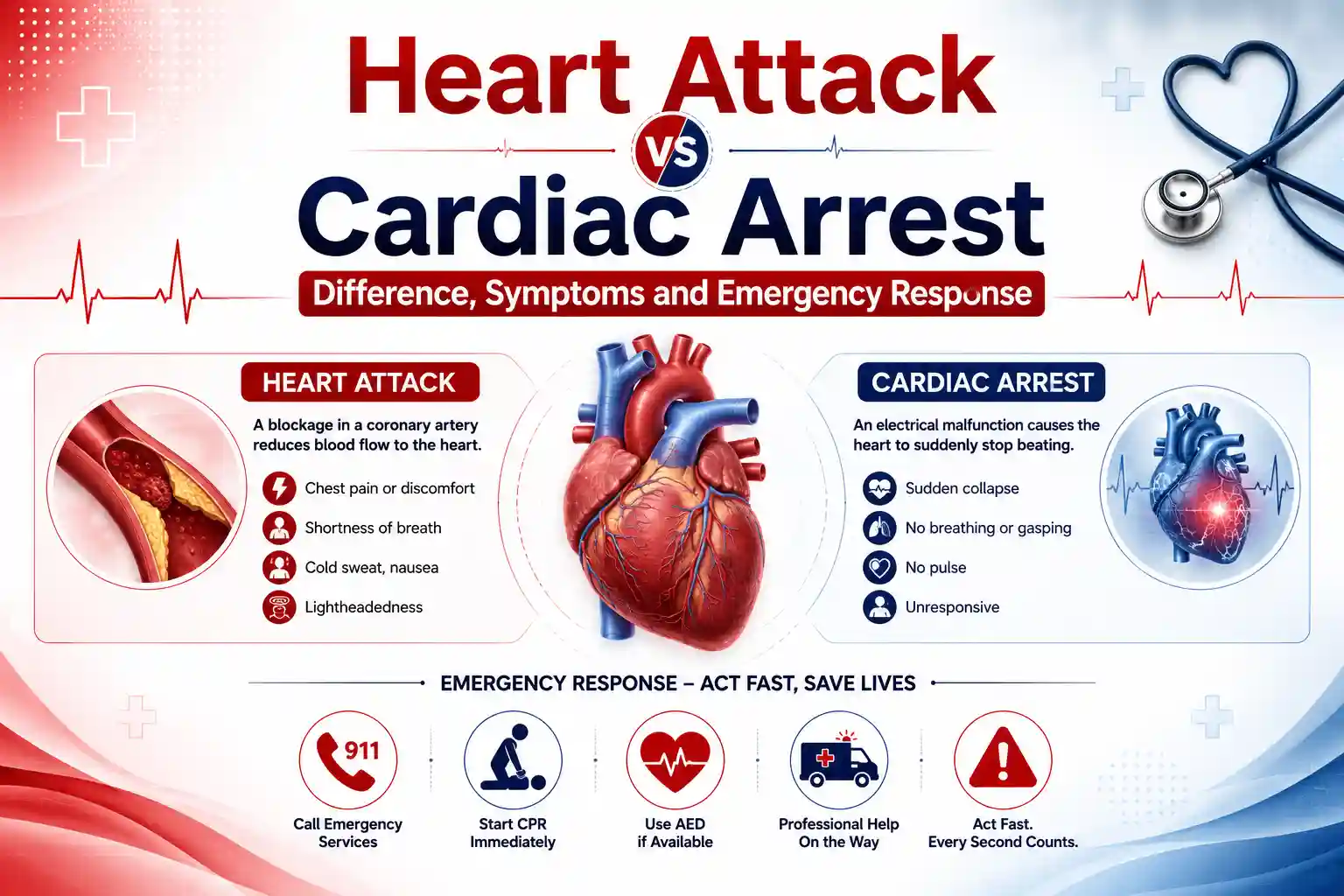
A heart attack, medically called a myocardial infarction, happens when blood flow to part of the heart muscle is blocked. This is usually caused by a blood clot that forms over a fatty plaque deposit inside a coronary artery. According to the American Heart Association, a heart attack is fundamentally a circulation problem, and the longer the blockage goes untreated, the more heart muscle is damaged.
During a heart attack, the heart usually keeps beating. Common symptoms include chest pain or pressure that can feel like squeezing or heaviness, pain spreading to the arm, jaw, neck, or back, breathlessness, cold sweats, nausea, and unusual fatigue. Symptoms can appear suddenly and intensely, or they can build up slowly over several minutes to hours. Some people, especially women, experience only the milder or less typical signs, which is one reason heart attacks in women are diagnosed later than in men.
Cardiac arrest is a different kind of emergency altogether. According to the Cleveland Clinic, cardiac arrest is an electrical failure in which the heart's rhythm suddenly becomes so abnormal that it stops pumping blood effectively. An arrhythmia called ventricular fibrillation is the most common trigger.
When cardiac arrest happens, the heart stops beating in an organized way, and a person becomes unconscious within seconds because blood is no longer reaching the brain. Breathing stops. There is no pulse. Without treatment, cardiac arrest is fatal within minutes. It can happen in a person with known heart disease or in someone who appeared completely healthy, and it is not always preceded by warning signs.
The clearest way to see the difference between cardiac arrest and heart attack is side by side:
| Aspect | Heart Attack | Cardiac Arrest |
|---|---|---|
| Underlying problem | Circulation problem: a blocked coronary artery | Electrical problem: a disrupted heart rhythm |
| What happens to the heart | Usually keeps beating | Stops beating |
| Onset | Can build up over minutes to hours, or hit suddenly | Sudden, with immediate collapse |
| Typical warning signs | Chest pain, pain in arm or jaw, breathlessness, nausea | No warning in most cases; sudden collapse |
| Immediate emergency response | Contact Germanten Hospital and get to a hospital fast for ECG and treatment | Contact Germanten Hospital, start CPR immediately, use an AED if available |
| Time sensitivity | Damage worsens the longer treatment is delayed | Can be fatal within minutes without CPR |
Cardiac arrest is generally the more time critical of the two conditions, since it can cause death within minutes without bystander action, while a heart attack causes escalating damage the longer it goes untreated. Heart attacks are also far more common than cardiac arrest, but a heart attack remains one of the most frequent triggers of cardiac arrest.
These two conditions are linked. According to Cedars-Sinai, sudden cardiac arrest can occur during a heart attack or during recovery from one, since a heart attack raises the risk of a dangerous rhythm disturbance. When part of the heart muscle is damaged or starved of oxygen, it can disrupt the heart's electrical signals.
Most heart attacks do not progress to cardiac arrest. This is exactly why chest pain, breathlessness, or other heart attack symptoms should never be ignored or waited out at home. Getting to a hospital quickly for an ECG and treatment lowers the risk that a heart attack will progress into cardiac arrest.
Heart attack symptoms in men often follow the textbook pattern: crushing central chest pain that spreads to the left arm or jaw. Women often experience more subtle signs, including pain in the back, neck, or jaw, along with shortness of breath, nausea, and unusual fatigue, sometimes without significant chest pain at all.
Cardiac arrest looks different from both a heart attack and a stroke. A stroke affects blood flow to the brain and typically causes one sided weakness, slurred speech, or facial drooping, while the person usually remains conscious and breathing. Cardiac arrest causes sudden collapse, no pulse, no breathing, and complete loss of consciousness. If someone suddenly collapses and does not respond, assume cardiac arrest and act immediately rather than waiting to see if they recover on their own.
Do not wait to see if the pain passes. Keep the person calm and seated or lying down. If a medical professional advises it over the phone and the person is not allergic, chewing an aspirin may help, but this should never delay reaching out for help. Avoid driving the person yourself if an ambulance is available, since paramedics can begin treatment on the way to the hospital.
Contact Germanten Hospital immediately, or ask someone nearby to call while you act. According to the American Heart Association, hands-only CPR, pressing hard and fast in the center of the chest, can double or triple a person's chance of survival. Use an AED (automated external defibrillator) if one is available nearby, and continue CPR until paramedics arrive.
Every second counts in both situations, but especially in cardiac arrest, where survival drops sharply with each passing minute. Quick access to cardiac care in Hyderabad, including an ECG, blood tests, and cath lab support, is what determines how much heart muscle is saved in a heart attack and how successfully someone is resuscitated after cardiac arrest.
India has seen a troubling rise in heart attack deaths in recent years. Government crime record data cited in a 2024 review published in Current Cardiology Reviews recorded a 12.5 percent rise in heart attack deaths in India in 2022 alone. Bystander CPR training is still far less common in India than in countries with higher cardiac arrest survival rates. Learning the difference between a heart attack and cardiac arrest, and learning basic hands-only CPR, are two of the simplest ways families in Hyderabad can prepare for a cardiac emergency before it happens.
Heart attack and cardiac arrest are two different emergencies, but they share one thing in common: every minute without treatment raises the risk of permanent damage or death. Learning to tell the two apart, and knowing to contact Germanten Hospital without hesitation, gives you the best chance of helping someone survive.
If you or a family member experiences chest pain, breathlessness, or any of the warning signs described here, do not wait to see if it passes. The cardiology team at Germanten Hospitals in Attapur, Hyderabad, provides round the clock emergency evaluation, ECG, and cath lab support for exactly these situations. If symptoms are active right now, walk in for an emergency evaluation without delay.
If you are not in the middle of an emergency but have risk factors such as high blood pressure, diabetes, high cholesterol, or a family history of heart disease, a preventive heart checkup is one of the simplest ways to catch problems early.Book a cardiology appointment with our team to get your heart health assessed.
No. A heart attack is a circulation problem caused by a blocked artery. Cardiac arrest is an electrical problem that causes the heart to stop beating. They are related, but they are not the same condition, and each needs a different emergency response.
Yes. A heart attack can damage the heart muscle and disrupt its electrical signals, which can trigger cardiac arrest during the event or during recovery. Most heart attacks, however, do not lead to cardiac arrest if they are treated quickly.
No. Myocardial infarction is simply the medical term for a heart attack. It describes the same circulation problem, and it remains a different condition from cardiac arrest, which is an electrical malfunction of the heart.
A stroke is caused by a blockage or bleed affecting blood flow to the brain. It usually causes one sided weakness, slurred speech, or facial drooping, and the person typically stays conscious. Cardiac arrest causes sudden collapse, no pulse, and complete loss of consciousness.
Cardiac arrest usually strikes without warning. The clearest signs are sudden collapse, no response to shouting or shaking, no normal breathing, and no detectable pulse. A few people report fatigue or palpitations beforehand, but many have no warning at all.
Contact Germanten Hospitals immediately, check for breathing and a pulse, and start hands-only CPR if both are absent. Keep going until paramedics arrive or an AED becomes available. Fast action in the first few minutes gives the best chance of survival.