An electrocardiogram, commonly called an ECG or EKG, is the most widely used cardiac investigation in medicine. It records the electrical activity of the heart through electrodes placed on the skin of the chest, arms, and legs, producing a trace that cardiologists use to evaluate heart rate, rhythm, conduction, and to identify evidence of heart attack, ischemia, hypertrophy, and many other cardiac conditions.
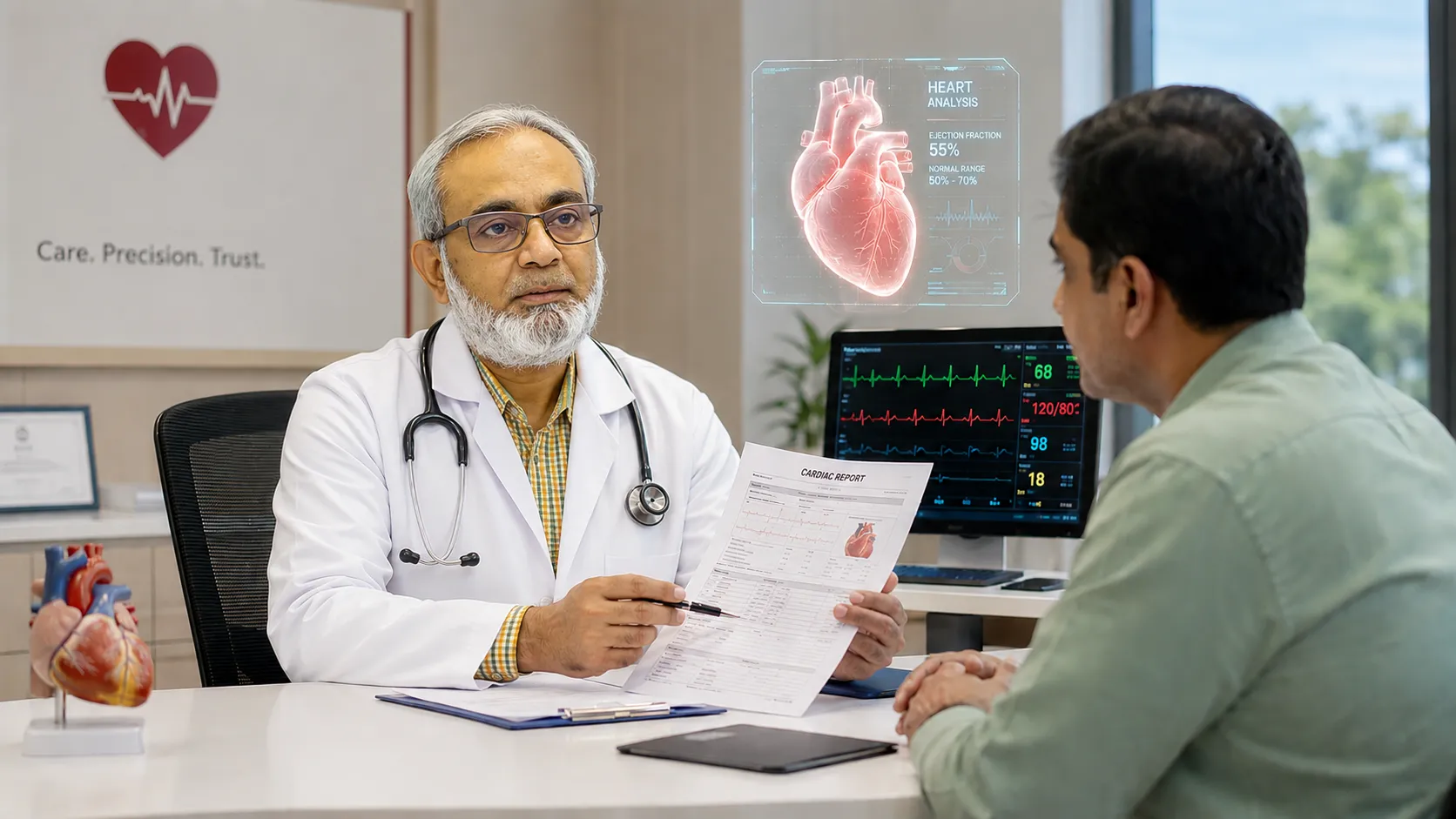
At Germanten Hospital, Attapur, a resting 12-lead ECG is available on a walk-in basis with same-day reporting. All ECGs are reviewed and interpreted by our senior cardiologist team. Results are discussed with the patient at the time of reporting and integrated into the wider clinical picture if further investigation or treatment is needed.
With each heartbeat, the heart generates a wave of electrical activity that spreads from the sinoatrial node in the right atrium, through the atrial muscle, down through the AV node and the bundle of His, and out through the Purkinje fibers into the ventricular muscle. A 12-lead ECG records this electrical wave from 12 different angles simultaneously, providing a comprehensive view of the heart's electrical behavior from every direction.
Represents atrial depolarization, the electrical activation of the upper chambers. Abnormal P waves indicate atrial enlargement, rhythm disturbances, or conduction delay between atria.
The time from the start of atrial activation to the start of ventricular activation, reflecting conduction through the AV node. Prolonged PR interval indicates first-degree heart block.
Represents ventricular depolarization, the electrical activation of the lower chambers. Width, morphology, and axis of the QRS reveal bundle branch blocks, ventricular hypertrophy, and prior heart attack.
The segment between ventricular activation and repolarization. Elevation indicates acute myocardial infarction or pericarditis. Depression indicates ischemia or posterior infarction. Critical for heart attack diagnosis.
Represents ventricular repolarization. Inversion can indicate ischemia, hypertrophy, or cardiomyopathy. Peaked T waves can indicate hyperkalemia (dangerously high potassium).
The total time for ventricular activation and recovery. Prolonged QT interval increases risk of dangerous ventricular arrhythmias including Torsades de Pointes. Measured to assess medication safety and congenital long QT syndrome.
Calculated from the interval between consecutive QRS complexes. Normal resting rate is 60 to 100 beats per minute.
Whether the rhythm is regular or irregular, and whether it originates from the sinus node (sinus rhythm) or from an abnormal site (ectopic rhythm). Atrial fibrillation, flutter, SVT, and ventricular arrhythmias all produce characteristic ECG patterns.
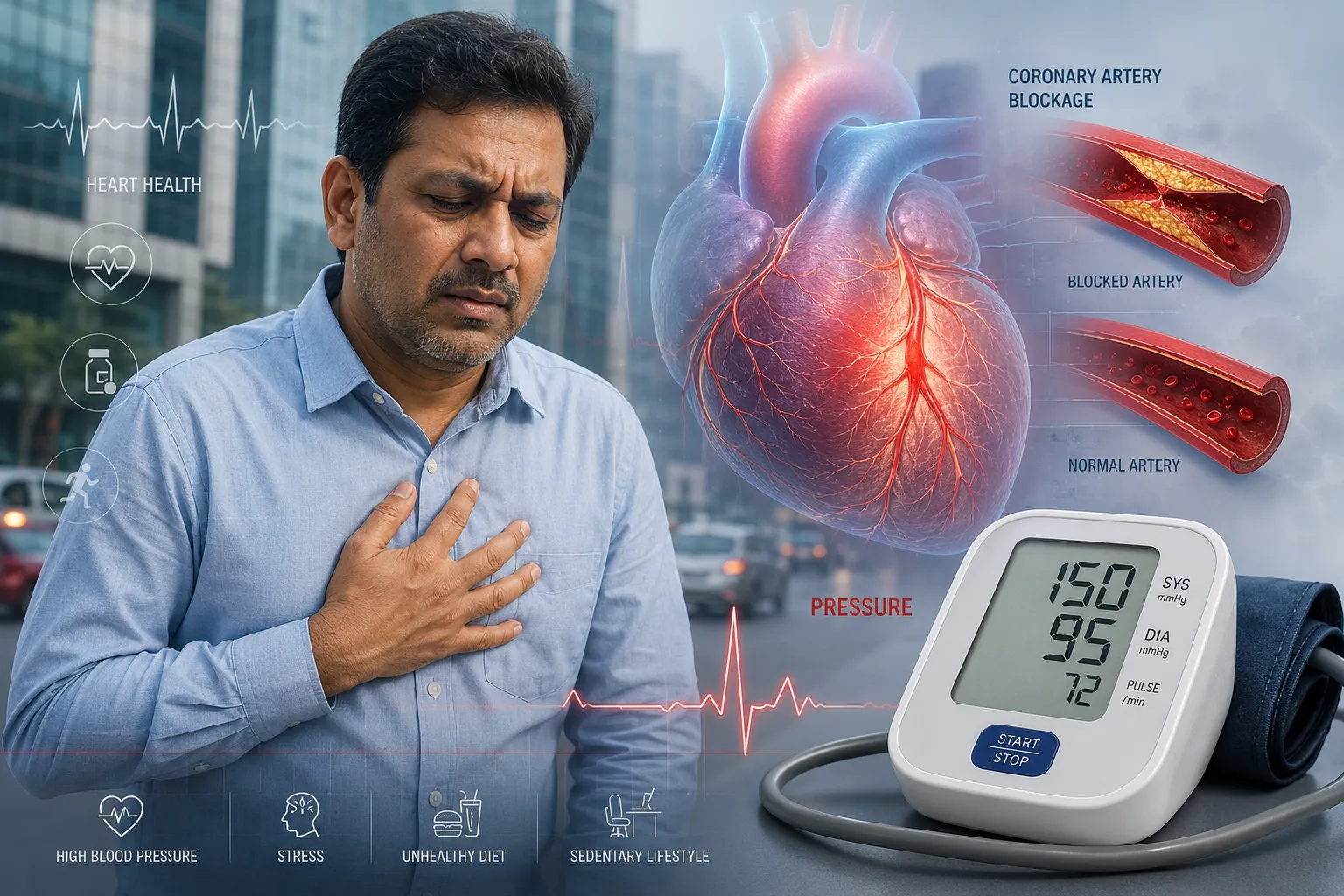
ST elevation on ECG is the key finding that triggers emergency angioplasty. Early ECG in chest pain is time-critical. Every minute of delay matters.
Q waves and ST-T changes from a previous heart attack persist on ECG for life, allowing identification of prior cardiac events even decades later.
ST depression and T-wave changes during chest pain or on a resting ECG indicate reduced blood supply to the heart muscle.
The hallmark ECG finding is absence of P waves and an irregularly irregular ventricular rhythm. Identified immediately on a 12-lead ECG if present at the time of recording.
Prolonged PR interval, dropped beats, or complete dissociation between P waves and QRS complexes reveal first, second, or third-degree AV block.
Abnormal QRS morphology indicating delayed conduction down the left or right bundle of His, which can be a sign of underlying cardiac disease or a marker of increased cardiac risk.
Increased QRS voltage indicating thickening of the left ventricle, commonly from hypertension or hypertrophic cardiomyopathy.
A short PR interval and delta wave (slurred upstroke of the QRS) indicate an accessory pathway capable of causing SVT and, in some cases, sudden cardiac death during atrial fibrillation.
A characteristic right precordial ST pattern associated with risk of sudden cardiac death from ventricular fibrillation, often in young adults without structural heart disease.
Prolonged QT interval indicating risk of Torsades de Pointes ventricular arrhythmia. May be congenital or caused by medications.
Diffuse saddle-shaped ST elevation across multiple leads, typically with PR depression, distinguishable from the localized ST elevation of heart attack.
Peaked T waves in hyperkalemia, flattened T waves in hypokalemia, and prolonged QT in hypocalcemia all have characteristic ECG patterns that can guide urgent management.
No special preparation is required for a resting ECG. You can eat and drink normally beforehand. Wear clothing that allows easy access to the chest, arms, and lower legs.
Ten electrodes (small adhesive patches with gel) are placed on specific positions on your chest, both wrists, and both ankles. The positions are standardized internationally.
You lie still and breathe normally for approximately 10 seconds while the ECG machine records electrical signals from all 12 leads simultaneously. Movement or deep breathing can introduce artifact into the trace.
The entire procedure takes 5 to 10 minutes from electrode placement to completed recording.
The ECG is entirely painless. No electricity is passed into your body. The machine only records signals generated by your own heart.
At Germanten, all ECG tracings are reviewed by a senior cardiologist on the same day. The report is discussed with you directly and any abnormal findings are acted upon immediately.
An ECG is a snapshot of the heart's electrical activity at one moment in time. A normal resting ECG does not rule out all cardiac conditions. Intermittent arrhythmias, for example, may not be present during the recording. If symptoms are intermittent, a Holter monitor or stress test may be needed in addition.
An ECG records electrical activity. A 2D echo records mechanical function, chamber size, valve anatomy, and wall motion. They provide complementary information. An ECG can detect a prior heart attack; an echo shows how much function was lost.
A resting ECG captures 10 seconds of rhythm. A Holter monitor records continuously for 24 to 48 hours, capturing intermittent arrhythmias missed on a standard ECG.
A resting ECG shows the heart at rest. A treadmill stress test records the ECG during exercise, revealing ischemic changes that only appear when the heart is working hard and blood supply is challenged.
An ECG detects electrical consequences of coronary disease (ischemia, prior infarction). CT angiography directly images the coronary arteries to visualize plaque and blockages before electrical or functional changes occur.
Consult expert cardiologists in Hyderabad at Germanten Hospital
“Mr. MD Ibrahim Khan, 55 years old from Hyderabad, was admitted for Anterior Cruciate Ligament (ACL) surgery and was successfully treated at Germanten Hospital, Attapur by Dr. Mir Jawad Zar Khan, MS Orthopaedics, Joint Replacement Surgeon with 20 years of experience.”
“Mr. Abdul Ali, from Kenya, was suffering from knee pain. He visited Germanten Hospitals Hyderabad and was operated on by the top orthopaedist in Hyderabad, Dr. Mir Jawad Zar Khan. After the treatment, he is now able to lead a normal life. Before going back to his country, he shared his experience with the hospital.”
“Mr. Vishwanath Rao from Hyderabad approached Dr. Mir Jawad Zar Khan with severe knee pain. Dr. Jawad diagnosed his knee and suggested knee replacement surgery. After the surgery, Vishwanath Rao is now walking painlessly and without support. He and his family are grateful to Dr. Mir Jawad Zar Khan and Germanten Hospital.”
“Mr. Afeef from Hyderabad met with an accident, and his right-hand bone was fractured. He was taken to Germanten Hospital and treated by Dr. Mir Jawad Zar Khan, the best orthopedic surgeon in Hyderabad. After the surgery, he is now leading a normal life and is grateful to Dr. Jawad and the Germanten Hospital team.”
“Mr. Abdul Ali, 70 years old, was unable to walk due to osteoarthritis for 10 years. One of his nephews suggested Dr. Mir Jawad Zar Khan. He was diagnosed and suggested knee replacement surgery, which was successfully performed on 6th October 2019. Now, he walks without pain and support and is very grateful to Dr. Mir Jawad Zar Khan.”
“After pain in his hip made daily life difficult, Mr. Rabul Islam turned to the orthopedic expert at Germanten Hospital for help. Dr. Mir Jawad Zar Khan, MD of Germanten Hospital and Senior Orthopedic & Spine surgeon, performed total hip replacement surgery on Rabul Islam. Now he is enjoying life pain-free.”
Mr. Vishwanath Rao from Hyderabad, underwent Knee Replacement Surgery
Mr. MD Ibrahim Khan, 55 years old from Hyderabad, underwent ACL Surgery at Germanten Hospital.
Mr. Gulshan Kumar from Hyderabad, underwent Total Knee Replacement Surgery at Germanten Hospital.
Mrs. Deepika Rawat underwent ACL Reconstruction Surgery at Germanten Hospital.
Mr. Anil Ahuja, 65 years old from New Delhi, underwent Total Knee Replacement Surgery at Germanten Hospital.
Mr. Rabul Islam from Assam, underwent ACL Surgery at Germanten Hospital.
Mr. Abdul Ali, 70 years old from Dubai, underwent Knee Replacement Surgery at Germanten Hospital.
Mr. Afeef from Hyderabad, underwent Bone Fracture Surgery at Germanten Hospital.
Mr. Ibrahim, 25 years old from Dubai, underwent ACL Surgery at Germanten Hospital.
Mr. Abdul Ali, 20 years old from Kenya, underwent ACL Surgery at Germanten Hospital.
Connect with our experts doctors for guidance
Germanten Hospital is located in Attapur, one of South Hyderabad's most accessible neighborhoods. Patients from across southern and western Hyderabad can reach us within 20 to 30 minutes.