A 2D echocardiogram is an ultrasound scan of the heart. Using high-frequency sound waves directed at the heart through a probe placed on the chest, it produces real-time moving images of the heart's chambers, walls, and valves. An echocardiogram shows not just structure but function, allowing cardiologists to watch the heart contracting and relaxing, observe valves opening and closing, and measure blood flow velocities across every part of the cardiac cycle.
The 2D echo is the single most informative non-invasive cardiac test available. It is the primary investigation for heart failure, valve disease, cardiomyopathy, congenital heart disease, pericardial disease, and assessment of cardiac function before and after cardiac procedures. At Germanten Hospital, echocardiograms are performed by trained cardiac sonographers and reported by our senior cardiologist team with results available the same day.
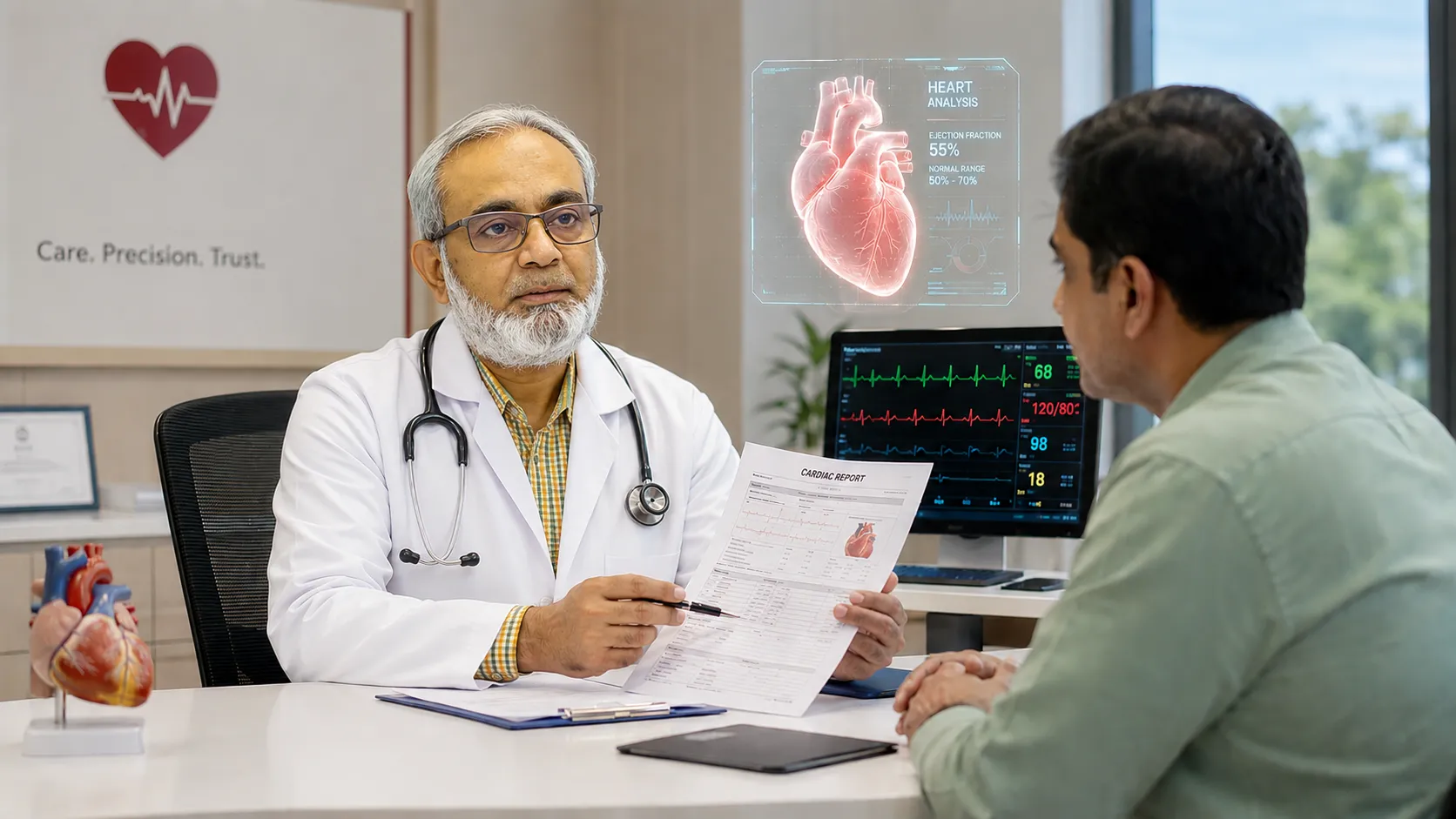
The percentage of blood pumped out of the left ventricle with each beat. Normal is 55 to 70%. EF below 40% indicates significant impairment and is the key measure in heart failure classification and treatment decisions.
Each segment of the ventricular wall is assessed for normal contraction. Reduced or absent wall motion in a specific region indicates ischemia or infarction in the corresponding coronary territory.
Chamber dimensions and volumes are measured. Enlargement indicates volume or pressure overload. Combined with EF, this guides decisions on valve surgery timing.
Right heart size and function, particularly relevant in pulmonary hypertension, right heart failure, and congenital heart disease.
All four valves are imaged and assessed using color Doppler to detect regurgitation and continuous wave Doppler to measure gradients across stenosed valves. Critical for aortic stenosis grading and mitral valve assessment.
The sac surrounding the heart is visualized. Fluid in the pericardial space (pericardial effusion) is identified and quantified. Tamponade physiology, where the fluid compresses the heart and impairs filling, has characteristic echo features.
Dimensions of the aortic root are measured, important for surveillance in Marfan syndrome, bicuspid aortic valve, and ascending aortic aneurysm.
How well the left ventricle relaxes and fills with blood between beats. Diastolic dysfunction is the hallmark of heart failure with preserved ejection fraction (HFpEF) and is graded on echo.
Doppler assessment of tricuspid regurgitation velocity estimates pulmonary artery pressure non-invasively. Elevated pulmonary pressure indicates pulmonary hypertension.
Thrombus (blood clots, particularly in the left atrial appendage in AFib or the left ventricle after heart attack), tumors, and vegetation from infective endocarditis are identified on echo.
The standard 2D echo. A probe is placed on the chest wall and images are obtained through the ribs. Covers all the assessments listed above. Non-invasive, safe, and produces no radiation.
An ultrasound probe is passed into the oesophagus (food pipe) under sedation. Provides higher-resolution images of structures behind the heart, including the mitral valve, left atrial appendage, and aorta. Used before valve procedures, to detect left atrial thrombus, and in infective endocarditis assessment.
2D echo images are acquired at rest and immediately after exercise (treadmill) or pharmacological stress (dobutamine infusion). Wall motion abnormalities that appear only under stress reveal areas of myocardium with inadequate blood supply not visible at rest.
Advanced imaging that reconstructs the heart in three dimensions. Particularly valuable for precise valve assessment before repair surgery and for guidance of structural heart interventions.
Agitated saline or ultrasound contrast agent is injected intravenously to improve endocardial border definition, detect intracardiac shunts (patent foramen ovale), or assess myocardial perfusion.
Measurement of ejection fraction and assessment of diastolic function classify heart failure type and guide treatment. Serial echos monitor response to therapy and cardiac remodeling.
Echo is the primary investigation for all valve conditions. It grades severity, guides timing of intervention, and monitors disease progression with serial studies.
Distinguishes dilated from hypertrophic from restrictive cardiomyopathy, measures hypertrophy in HCM, and detects outflow obstruction.
Regional wall motion abnormalities identify the territory of ischemia or infarction. Post-heart attack echo quantifies residual function and guides further management.
Measures atrial size, identifies valvular causes of AFib, and assesses left ventricular function before cardioversion or ablation.
Detects pericardial effusion, quantifies its size, and identifies tamponade physiology requiring urgent drainage.
Identifies structural defects including ASD, VSD, and valve abnormalities. Essential for planning catheter closure procedures.
Baseline cardiac function assessment before major surgery. Identifies unsuspected valve disease or reduced ejection fraction that may affect operative risk.
Aortic valve area and gradient measurements determine severity of aortic stenosis and suitability for TAVI. Post-TAVI echo confirms valve function.
No fasting or special preparation is needed for a standard transthoracic echo. Wear comfortable clothing that allows easy access to the chest.
You lie on your left side on an examination couch. This position tilts the heart slightly forward, improving the ultrasound window through the ribs.
Ultrasound gel is applied to the chest to eliminate air between the probe and skin. Air blocks ultrasound transmission.
The sonographer moves the probe to several positions on the chest, left side of the sternum, the apex of the heart, and below the ribcage, to obtain views from different angles. The probe is held firmly but does not cause pain.
Color Doppler and spectral Doppler measurements are added to assess blood flow through valves and to measure velocities and gradients.
A standard resting echo takes 20 to 30 minutes. Stress echo or complex assessments take longer.
At Germanten, all echos are reported by a senior cardiologist the same day. The report is issued with measurements, images, and a clinical summary. Findings are discussed with you directly.
Consult expert cardiologists in Hyderabad at Germanten Hospital
“Mr. MD Ibrahim Khan, 55 years old from Hyderabad, was admitted for Anterior Cruciate Ligament (ACL) surgery and was successfully treated at Germanten Hospital, Attapur by Dr. Mir Jawad Zar Khan, MS Orthopaedics, Joint Replacement Surgeon with 20 years of experience.”
“Mr. Abdul Ali, from Kenya, was suffering from knee pain. He visited Germanten Hospitals Hyderabad and was operated on by the top orthopaedist in Hyderabad, Dr. Mir Jawad Zar Khan. After the treatment, he is now able to lead a normal life. Before going back to his country, he shared his experience with the hospital.”
“Mr. Vishwanath Rao from Hyderabad approached Dr. Mir Jawad Zar Khan with severe knee pain. Dr. Jawad diagnosed his knee and suggested knee replacement surgery. After the surgery, Vishwanath Rao is now walking painlessly and without support. He and his family are grateful to Dr. Mir Jawad Zar Khan and Germanten Hospital.”
“Mr. Afeef from Hyderabad met with an accident, and his right-hand bone was fractured. He was taken to Germanten Hospital and treated by Dr. Mir Jawad Zar Khan, the best orthopedic surgeon in Hyderabad. After the surgery, he is now leading a normal life and is grateful to Dr. Jawad and the Germanten Hospital team.”
“Mr. Abdul Ali, 70 years old, was unable to walk due to osteoarthritis for 10 years. One of his nephews suggested Dr. Mir Jawad Zar Khan. He was diagnosed and suggested knee replacement surgery, which was successfully performed on 6th October 2019. Now, he walks without pain and support and is very grateful to Dr. Mir Jawad Zar Khan.”
“After pain in his hip made daily life difficult, Mr. Rabul Islam turned to the orthopedic expert at Germanten Hospital for help. Dr. Mir Jawad Zar Khan, MD of Germanten Hospital and Senior Orthopedic & Spine surgeon, performed total hip replacement surgery on Rabul Islam. Now he is enjoying life pain-free.”
Mr. Vishwanath Rao from Hyderabad, underwent Knee Replacement Surgery
Mr. MD Ibrahim Khan, 55 years old from Hyderabad, underwent ACL Surgery at Germanten Hospital.
Mr. Gulshan Kumar from Hyderabad, underwent Total Knee Replacement Surgery at Germanten Hospital.
Mrs. Deepika Rawat underwent ACL Reconstruction Surgery at Germanten Hospital.
Mr. Anil Ahuja, 65 years old from New Delhi, underwent Total Knee Replacement Surgery at Germanten Hospital.
Mr. Rabul Islam from Assam, underwent ACL Surgery at Germanten Hospital.
Mr. Abdul Ali, 70 years old from Dubai, underwent Knee Replacement Surgery at Germanten Hospital.
Mr. Afeef from Hyderabad, underwent Bone Fracture Surgery at Germanten Hospital.
Mr. Ibrahim, 25 years old from Dubai, underwent ACL Surgery at Germanten Hospital.
Mr. Abdul Ali, 20 years old from Kenya, underwent ACL Surgery at Germanten Hospital.
Connect with our experts doctors for guidance
Germanten Hospital is located in Attapur, one of South Hyderabad's most accessible neighborhoods. Patients from across southern and western Hyderabad can reach us within 20 to 30 minutes.