Echo Test, ECG, Holter & Troponin Test: A Complete Guide to Cardiac Diagnosis
Aug 18, 2026
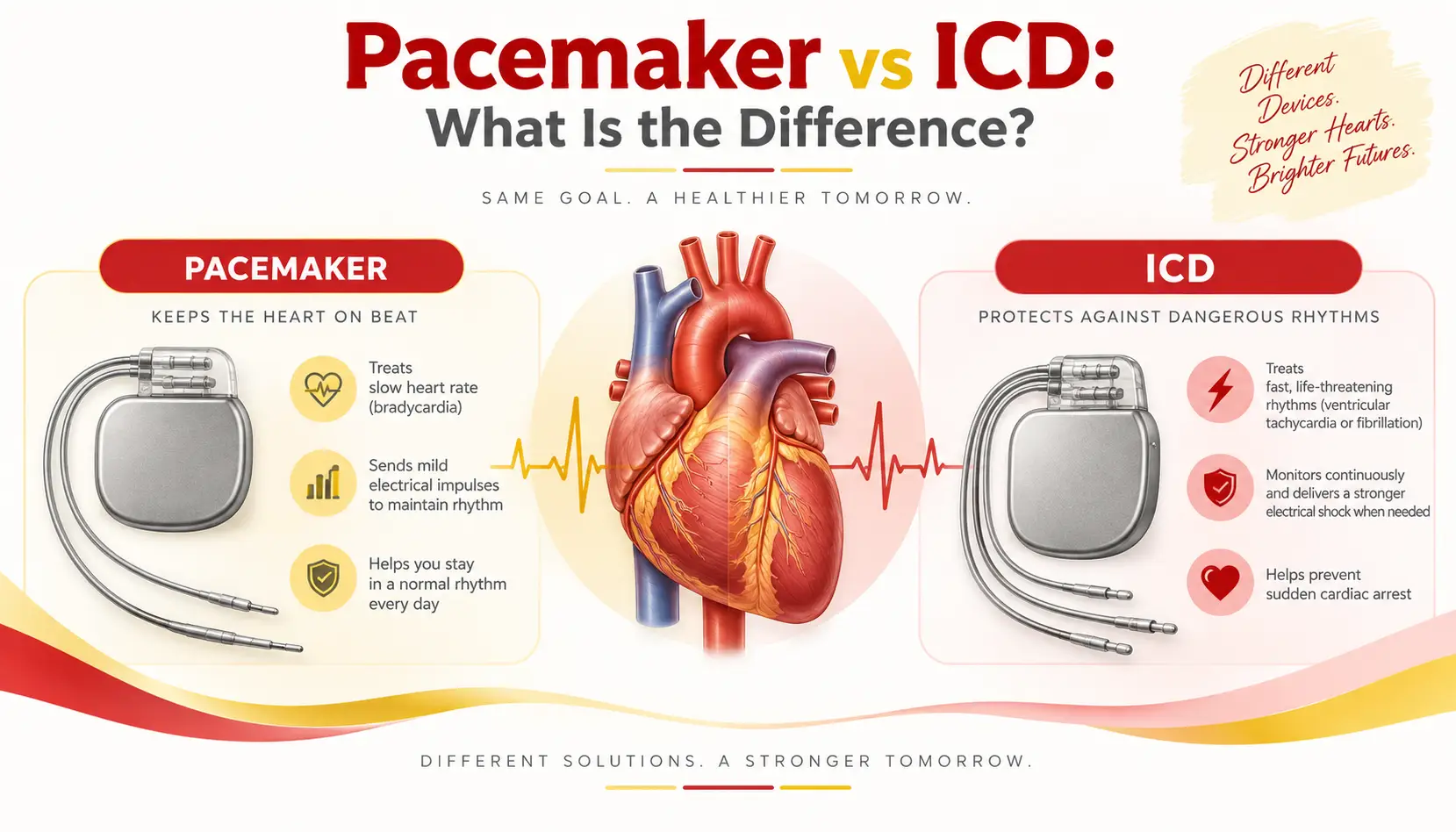
Image Disclaimer: AI-generated illustration for educational purposes.*
If you are comparing a cardioverter vs pacemaker, the key question is what heart-rhythm problem the device needs to address. A pacemaker mainly helps when the heart beats too slowly or its electrical signals do not travel properly. An implantable cardioverter defibrillator (ICD) watches for certain dangerous, very fast rhythms and can deliver treatment to stop them.
The distinction sounds straightforward, but devices can have overlapping functions. Some ICDs can also provide pacing, while some specialised devices help the heart’s chambers beat in better coordination. The right choice depends on a confirmed diagnosis and an individual assessment not simply whether a pulse reading is high or low.
| Feature | Pacemaker | Implantable Cardioverter Defibrillator (ICD) |
|---|---|---|
| Main purpose | Helps maintain an appropriate heartbeat when it is too slow or electrical signals are delayed | Detects and treats selected life-threatening fast rhythms |
| How it responds | Sends small electrical impulses when pacing is needed | May use rapid pacing or deliver a shock, depending on the device and rhythm |
| Often considered for | Certain symptomatic slow rhythms and significant electrical heart block | People at substantial risk of dangerous rhythms such as ventricular tachycardia or ventricular fibrillation |
| Can it deliver a defibrillation shock? | A standard pacemaker cannot | Yes |
| Can it provide pacing? | Yes | Many ICDs can, but capabilities vary by device type |
Neither device is “better” in general. Each is chosen to address a different risk. Some people need neither device, even if they have palpitations or an occasional abnormal heart-rate reading.
Your heart has an electrical system that tells it when to beat. If those signals are generated too slowly or have trouble travelling through the heart, the rate may become too slow for the body’s needs.
A pacemaker monitors the heartbeat and sends small electrical impulses when pacing is needed. Many people do not feel those impulses. A traditional device usually has a small generator placed under the skin and one or more thin wires, called leads, that connect it to the heart. Some people may be suitable for a leadless pacemaker, which is placed inside the heart through a catheter.
A doctor may consider pacing for certain people with:
Heart block is an electrical-signal problem. It is not the same as a blocked coronary artery. Also, a low pulse number alone does not mean you need an implanted pacemaker. The cause, symptoms and heart-rhythm recordings matter.
ICD stands for implantable cardioverter defibrillator. It continuously monitors the heart’s rhythm. If it detects a dangerous rhythm arising from the heart’s lower chambers, it can deliver treatment intended to restore a safer rhythm.
The rhythms of concern include ventricular tachycardia, a dangerously fast rhythm, and ventricular fibrillation, a chaotic rhythm that cannot pump blood effectively. Depending on the device and the rhythm, treatment may begin with rapid electrical pacing or involve a shock.
An ICD may be recommended for someone who has survived certain life-threatening rhythm events or is judged to be at substantial risk of one. That decision requires careful evaluation. An ICD does not treat every type of palpitation or every fast heartbeat, and having heart failure does not automatically mean a person needs one.
Many transvenous ICDs can provide pacing if the heart becomes too slow. Some can also use rapid pacing to interrupt certain fast rhythms. However, ICD designs differ. A subcutaneous ICD, for example, does not provide the same ongoing pacing functions as a conventional transvenous ICD.
This is an important question to ask if you have been advised to get a device: “Does the model recommended for me also provide the kind of pacing I may need?” The answer depends on your rhythm condition and the specific device.
People may also hear the term cardiac resynchronisation therapy (CRT). CRT is designed to help the heart’s lower chambers contract in a more coordinated way in selected people with heart failure.
A CRT-P provides resynchronisation pacing. A CRT-D combines resynchronisation with defibrillator capability. These are not routine upgrades that everyone needs; they address particular findings on heart tests.
This is why the conversation should begin with the problem being treated, rather than the device name. A person might need protection from a slow rhythm, a dangerous fast rhythm, poorly coordinated pumping or a combination. Tests help the care team identify which situation applies.
A device recommendation is based on more than one test or one symptom. Your clinician may review:
For example, if a slow rhythm is linked to a medicine or another treatable issue, the team will consider that information before deciding on a permanent device. If an ICD is being discussed, ask which specific rhythm risk it is intended to address and how that risk was assessed.
An ejection-fraction number or a smartwatch alert should not be used alone to choose a device. The full clinical picture matters.
Not necessarily. Atrial fibrillation is an irregular rhythm that starts in the heart’s upper chambers. Its assessment and treatment are different from those for a dangerous ventricular rhythm. Some people with atrial fibrillation may also have a separate reason for a pacemaker, but the atrial-fibrillation diagnosis itself does not automatically call for a pacemaker or ICD.
If you have been told you have an irregular heartbeat, ask your clinician what type of rhythm was recorded. That is more useful than relying on the broad label “arrhythmia.”
Both traditional pacemakers and transvenous ICDs are usually placed through a procedure in which the generator sits under the skin and leads connect it to the heart. The details differ by device type; leadless pacemakers and subcutaneous ICDs use different approaches. Your team will explain the method recommended for you.
Before the procedure, discuss your medicines, allergies and other health conditions. Afterwards, you will receive instructions for caring for the wound, moving the arm on the implant side, returning to activities and attending device checks. Follow your own discharge instructions, as restrictions and recovery vary.
Tell the care team promptly if the wound becomes increasingly red or swollen, you develop a fever, or you have another concern about the implant site. Do not assume that a device removes the need for heart medicines or follow-up appointments.
Most people with an implanted device need regular checks. At these visits, the team can review how the device has been working, check its battery and settings, and discuss any symptoms. Some devices can also send information remotely. Keep the device identification card you are given and show it when you receive medical care.
Tell healthcare professionals about the implant before scans or procedures. Whether an MRI is possible depends on the device system and the imaging team’s safety process; do not assume that all implants either permit or prohibit MRI. Ask your device team about strong magnets and any equipment relevant to your work or daily life.
If you have an ICD, agree on a clear plan for what to do if it delivers a shock. Follow the instructions from your own device clinic. Repeated shocks, a shock accompanied by chest pain or fainting, or feeling seriously unwell warrants emergency medical help.
A good device discussion should leave you knowing why it is recommended. Consider asking:
For planned assessment, Germanten Hospitals’ pacemaker implantation service in Hyderabad and arrhythmia care in Hyderabad pages provide relevant service information. These links are for non-emergency decisions; fainting, severe chest pain or serious breathing difficulty needs urgent care.
A pacemaker helps the heart maintain an appropriate rhythm when pacing is needed. An ICD protects against selected life-threatening fast rhythms and may also provide pacing, depending on its design. Because these functions can overlap, the most useful question is not “Which device is better?” but “Which risk do my test results show, and how will this device address it?”
No. A pacemaker mainly supports a heart rhythm that is too slow or has a significant electrical conduction problem. An ICD detects and treats certain dangerous fast rhythms. Many ICDs also have pacing features, but capabilities differ by device.
Neither is better for everyone. The appropriate device depends on the specific rhythm problem, symptoms, test results and risk of a life-threatening arrhythmia. A cardiologist must assess those factors before recommending one.
A standard pacemaker sends small pacing impulses; it does not deliver a defibrillation shock. An ICD can deliver a shock when it detects a rhythm that requires it.
Some people need both pacing and defibrillator functions. Many transvenous ICDs can provide pacing, and certain combined devices offer additional functions. The right configuration depends on the individual’s condition.
No. A slow rate can occur for different reasons and does not automatically require an implant. A clinician considers symptoms, rhythm recordings, medicines and possible reversible causes.
No. Some people with heart failure may benefit from an ICD, CRT device or both, but many do not meet the criteria. The decision depends on heart function, rhythm risk, overall health and other clinical findings.
Follow the action plan provided by your device team and contact them as instructed, even if you feel well afterwards. Seek emergency medical help for repeated shocks or if a shock occurs with chest pain, fainting or other serious symptoms.
Medical Disclaimer: This article is for general informational and educational purposes only and should not be considered medical advice, diagnosis, or treatment. Please consult a qualified healthcare professional for personalized medical guidance.