10 Massages and Stretches for a Frozen Shoulder
June 15, 2023
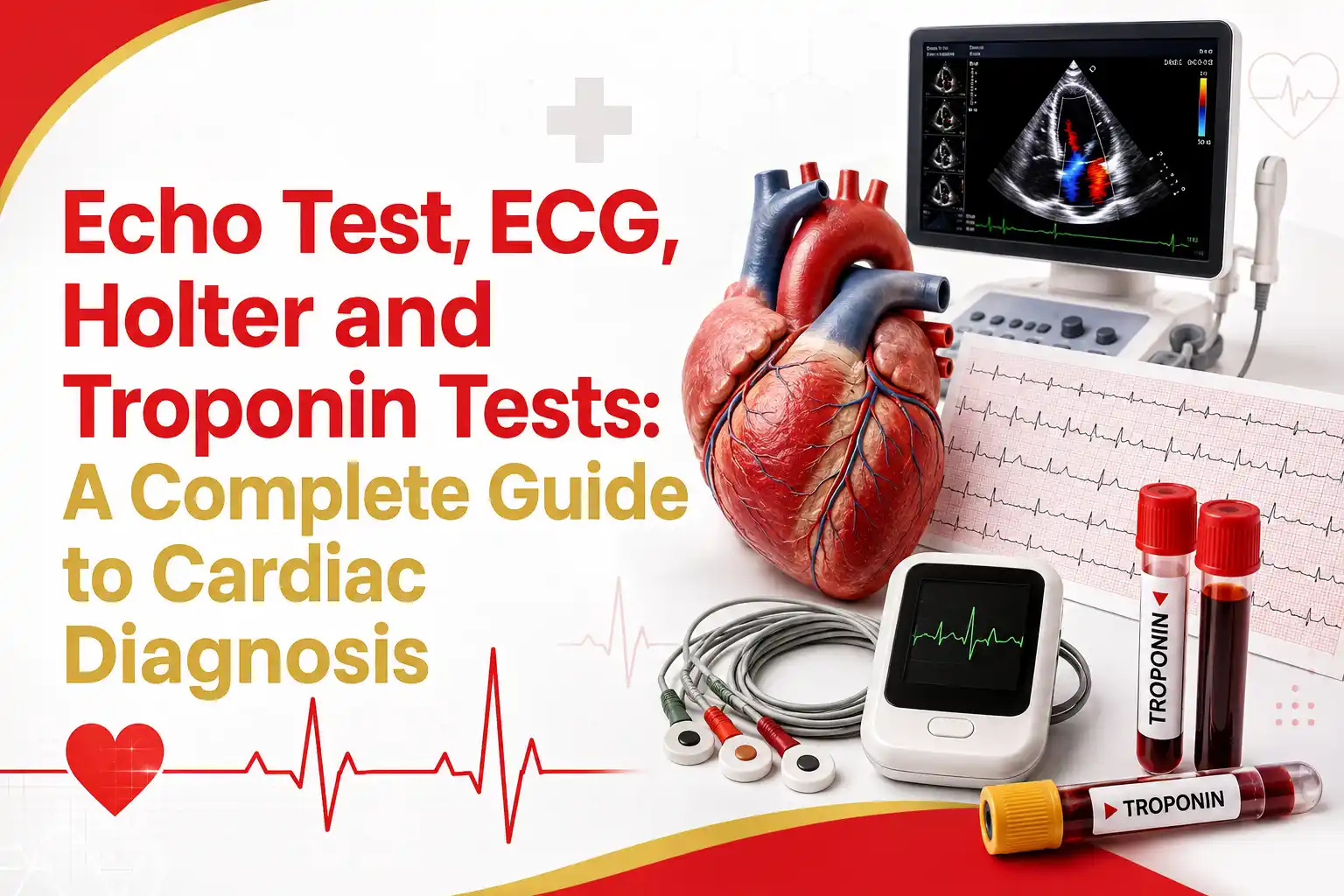
An echo test is one of several investigations a cardiologist may use to understand how your heart is functioning. Depending on your symptoms, you may also be advised an ECG, Holter monitor, troponin blood test, treadmill stress test or coronary imaging.
These tests do not all measure the same thing. An ECG records electrical activity, an echocardiogram creates images of heart structure and movement, a Holter monitor records electrical activity over a longer period, and troponin is a blood test used when heart-muscle injury is suspected.
Understanding why each test is ordered can make a cardiac evaluation less confusing and can also help patients avoid trying to interpret one test in isolation.
An echo test, or echocardiogram, uses ultrasound to create moving images of the heart. It can help clinicians assess the chambers, walls, valves and pumping function of the heart. Unlike an ECG, an echocardiogram provides structural and functional images rather than recording electrical signals.
Patients who have specifically been advised an echo test in Hyderabad may undergo 2D echocardiography to assess the heart's structure and function.
For someone searching “2D echocardiography means”, the simplest explanation is this: a 2D echocardiogram is an ultrasound scan that creates two-dimensional moving images of the heart. It allows the cardiology team to watch the heart contract and relax and to assess important structures in real time.
A 2D echo may help assess:
During a standard transthoracic 2D echo test, the patient generally lies on an examination couch while a trained professional moves an ultrasound probe over different areas of the chest. Gel is applied to help the probe transmit sound waves and obtain clear images.
A standard transthoracic echo is non-invasive and does not involve inserting a catheter into an artery. It is different from specialised tests such as transoesophageal echocardiography or stress echocardiography, which are used for specific clinical questions.
The ECG full form in medical terminology is Electrocardiogram. You may also see the abbreviation EKG. Both refer to a test that records the electrical signals generated by the heart. An ECG can help clinicians assess heart rate, rhythm and certain electrical patterns.
An ECG may be advised when a patient reports chest pain, palpitations, shortness of breath, dizziness, fainting or an irregular heartbeat, or as part of an assessment for known or suspected heart disease.
ECG, echocardiography, stress testing, Holter monitoring and cardiac imaging may form part of the diagnostic services provided through a cardiology hospital in Hyderabad.
ECG एक ऐसी जाँच है जो दिल कि electrical activity यानी हृदय कि विद्युत गतिविधि को रिकॉर्ड करती है। इससे डॉक्टर दिल कि धड़कन कि गति और rhythm को समझनें में मदद लेतें हैं।
Electrodes placed on the skin detect electrical signals generated by the heart. The test is quick and non-invasive. An ECG does not provide the same information as an echo, which is why a cardiologist may recommend both tests when they need information about both electrical activity and heart structure.
A simple way to remember the difference is: ECG evaluates electrical activity, while an echo evaluates structure and movement. An ECG can identify rhythm abnormalities and certain electrical changes. An echocardiogram shows the chambers, valves, wall motion and pumping function of the heart.
Neither test is automatically “better”. They answer different clinical questions and are often complementary.
A Holter monitor is a small portable ECG recording device worn while a person continues normal daily activities. A standard resting ECG records only a short period, while a Holter monitor records the heart rhythm over a much longer period. This can be useful when symptoms such as palpitations, dizziness, fainting or intermittent rhythm changes are not present during a brief ECG.
The keyword “Holter cost” has commercial intent, but there is no universal price. The final amount can depend on the duration of monitoring, device type, fitting, data analysis, cardiologist reporting and whether a consultation is included.
The medically important question is not only the price. It is whether the monitoring duration is appropriate for how often the symptoms occur. Someone with daily palpitations may need a different monitoring strategy from a person whose symptoms happen only once every few weeks.
Troponin is a protein associated with heart muscle. When heart-muscle cells are injured, troponin can enter the bloodstream. A troponin blood test is commonly used when clinicians are evaluating a possible heart attack or another cause of myocardial injury.
Troponin is interpreted together with symptoms, ECG findings, medical history and changes in blood-test values over time. A single result should not be self-diagnosed using a reference number found online because laboratory assays and clinical thresholds can differ.
Troponin test एक blood test है जिसका इस्तेमाल डॉक्टर दिल कि मांसपेशियों को नुकसान हुआ है या नहीं, यह समझने के लिए करते हैं। Heart attack का संदेह होने पर ECG और दूसरे clinical findings के साथ यह test महत्वपूर्ण हो सकता है।
If a patient has active chest pain, severe breathlessness, sweating, fainting or other symptoms suggesting an acute heart problem, they should seek urgent medical assessment rather than waiting for an outpatient blood test.
The correct investigation depends on the clinical question rather than on one test being universally better than another.
It is tempting to compare a report with values found online, but cardiac investigations should not be interpreted in isolation. An echo report contains multiple measurements rather than one single “normal” number. Troponin thresholds depend on the assay. ECG interpretation depends on rhythm, intervals, wave patterns, symptoms and medical history.
The safest approach is to have the report reviewed by the clinician who knows why the test was ordered and can interpret it in the context of symptoms and other findings.
Routine cardiac tests are useful for planned evaluation, but some symptoms require immediate medical care. New or severe chest pain, major breathlessness, fainting, cold sweating, sudden weakness or symptoms strongly suggestive of a heart attack should be assessed urgently.
New or severe symptoms may require heart attack treatment rather than waiting for a routine cardiac test.
An echo test, ECG, Holter monitor and troponin test provide different information about heart health. An echo looks mainly at the heart’s structure and function. An ECG records electrical activity. A Holter monitor provides longer-term rhythm recording, while troponin testing helps clinicians identify evidence of heart-muscle injury.
The right test depends on the patient’s symptoms, medical history and the question the cardiologist needs to answer. Avoid choosing or interpreting a cardiac test based only on internet search results.
Experiencing Heart-Related Symptoms?
If you have persistent palpitations, chest discomfort, unexplained breathlessness, dizziness or an abnormal heart-test report, consider a cardiologist in Hyderabad for appropriate clinical evaluation and test selection.
An echo, or echocardiogram, is an ultrasound test that creates moving images of the heart and helps assess its chambers, valves, walls and pumping function.
A standard transthoracic 2D echo is non-invasive. Some pressure from the probe may be felt, but it does not require an arterial catheter.
ECG stands for Electrocardiogram. It records the electrical activity of the heart.
No. They measure different aspects of the heart. ECG evaluates electrical activity, while echo evaluates structure and movement.
It records heart rhythm for a longer period and can help detect intermittent rhythm abnormalities that may not appear during a short ECG.
No. Troponin indicates heart-muscle injury, but the cause must be interpreted using symptoms, ECG findings, medical history and changes in the value over time.
Germanten Hospitals provides cardiac evaluation and diagnostic services in Hyderabad, with investigations selected according to the patient's symptoms and clinical requirements.
This article is for general information only and is not a substitute for professional medical advice, diagnosis or treatment. If you suspect a heart attack or other acute cardiac problem, seek emergency medical care immediately.