
Echo Test, ECG, Holter & Troponin Test: A Complete Guide to Cardiac Diagnosis
Aug 18, 2026
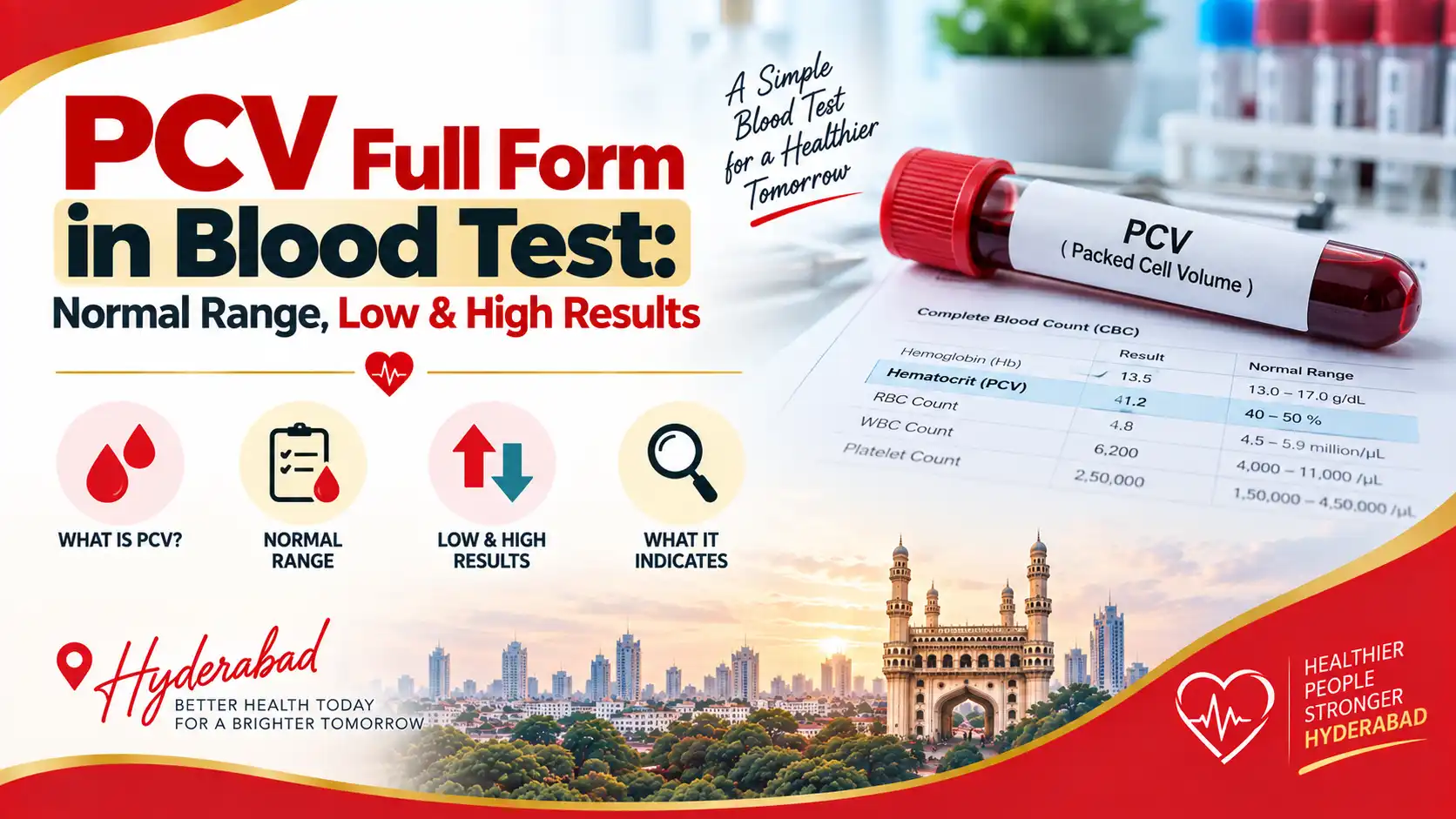
If you have seen “PCV” on a blood report, you may be wondering what it measures and whether your result is normal. The PCV full form in blood test reports is packed cell volume. It is also called haematocrit or HCT.
PCV tells you what percentage of your blood is made up of red blood cells. For example, a PCV of 42% means red blood cells occupy about 42% of the blood sample. The result can help a doctor investigate conditions such as anaemia, dehydration or an increased red blood cell count. It cannot identify the cause on its own.
The most useful first step is to compare your number with the reference range printed on your report. Then consider it alongside your haemoglobin level, other blood counts, symptoms and medical history.
Blood contains red blood cells, white blood cells, platelets and a liquid portion called plasma. Red blood cells carry oxygen from the lungs to the rest of the body. Packed cell volume describes the proportion of the blood occupied by those red blood cells.
Your report may use any of these labels for the same measurement:
PCV is usually reported as a percentage. Some laboratories report it as a decimal: 0.42 L/L is equivalent to 42%.
The word “packed” comes from a traditional way of measuring the test: when a blood sample is spun, red blood cells settle together at the bottom. Today, many laboratories calculate or measure haematocrit as part of an automated complete blood count.
A PCV blood test is commonly included in a complete blood count (CBC), also called a full blood count. A doctor may request a CBC during a routine check-up or to investigate symptoms such as fatigue, dizziness or breathlessness.
PCV can help with the assessment of:
PCV is one part of the picture. A doctor will usually review the red blood cell count, haemoglobin and red blood cell indices on the same report before deciding whether further tests are needed.
A commonly used example range for adults is:
| Group | Example PCV or haematocrit range |
|---|---|
| Adult men | 41%–50% |
| Adult women | 36%–44% |
These are examples, not universal cut-offs. Laboratories use different methods and reference ranges. Age, pregnancy, smoking and living at a high altitude can also affect interpretation. Children and newborns need age-specific ranges.
Always use the range supplied by the laboratory that tested your sample. A result slightly outside that range does not automatically mean you have a disease, just as a result inside it does not explain away ongoing symptoms.
It may be within the reference range for many adult women and below the range used for some adult men. The answer depends on your laboratory’s range and your circumstances. Your doctor may also look at whether the value has changed from previous reports.
It may be within the range for many adult men and above the range used by some laboratories for adult women. A single number should not be labelled high or low without checking the report’s reference range.
A low PCV means red blood cells occupy a smaller proportion of the blood sample than expected. It can be a sign of anaemia, but the result alone cannot tell you which type or what caused it.
Possible reasons include:
A low result can also occur with changes in the balance between blood cells and plasma. This is why the full report and clinical context matter.
Some people have no noticeable symptoms, particularly when the change is mild or gradual. Others may experience tiredness, weakness, dizziness, headaches, paleness, a fast heartbeat or shortness of breath.
These symptoms have many possible causes. If your PCV is low, avoid assuming that iron tablets are the answer. A doctor may need to establish whether iron deficiency, blood loss or another condition is responsible before recommending treatment.
A high PCV means red blood cells make up a larger proportion of the blood sample than the laboratory expects. Sometimes this happens because the liquid portion of the blood has decreased, as with dehydration. In other cases, the body may be producing more red blood cells.
Possible reasons include:
A high result does not, by itself, diagnose a blood disorder. Your doctor may recommend repeating the CBC, reviewing previous results and investigating the underlying cause if the elevation persists.
Depending on the cause, a person may notice headaches, dizziness, blurred vision, fatigue or shortness of breath. Some causes of high PCV have no obvious symptoms. Discuss a persistent high result with a doctor even if you feel well.
These three results are related, but they measure different things:
| Test | What it tells you |
|---|---|
| PCV or HCT | The percentage of blood volume occupied by red blood cells |
| Haemoglobin (Hb) | The amount of oxygen-carrying haemoglobin protein in the blood |
| RBC count | The number of red blood cells in a measured volume of blood |
A doctor also considers the size of the red blood cells, often shown as MCV on a CBC. Looking at these results together helps narrow down possible reasons for an abnormal PCV. No single value gives a complete diagnosis.
A healthcare professional takes a small blood sample, usually from a vein in your arm. You may feel a brief sting, and minor bruising can occur at the needle site. The sample is then analysed by the laboratory.
PCV testing on its own usually does not require fasting. If your doctor has ordered other tests at the same time, such as some blood sugar or cholesterol tests, you may receive separate preparation instructions. Check with the testing centre before your appointment.
If your PCV in a blood report is marked L for low or H for high, work through these questions with your clinician:
Do not change prescribed medication, start iron supplements or attempt to “correct” the number without understanding its cause.
Your doctor may decide that no immediate action is needed, recommend a repeat CBC or request additional tests. The next step depends on the direction of the change and your other findings.
For a low PCV, further assessment might include iron studies or ferritin, vitamin levels, kidney function tests or investigation of possible blood loss. For a high PCV, the doctor may assess hydration, oxygen levels, smoking history, sleep or breathing concerns, and whether the elevation persists on repeat testing.
An unexplained result is a suitable reason to arrange a general medicine consultation. If the blood counts remain abnormal or suggest a blood-related condition, your doctor may recommend specialist review through the hematology department.
Contact a doctor promptly if an abnormal PCV result occurs with worsening fatigue, breathlessness during ordinary activities, recurrent dizziness, unusual bleeding or a rapid change from earlier blood reports.
Seek emergency care for chest pain, severe breathlessness, fainting, confusion, stroke-like symptoms or significant ongoing bleeding. Do not wait for a routine appointment to discuss the PCV number in these situations.
If an abnormal PCV result occurs alongside heart-related symptoms or an existing heart condition, your clinician may also consider a cardiac assessment. cardiology hospital in Hyderabad provides care for heart conditions; the need for that assessment depends on your symptoms and medical history, not the PCV value alone.
The PCV full form in blood test reports is packed cell volume. It shows the proportion of your blood made up of red blood cells and can offer a useful clue when investigating anemia, dehydration or a high red blood cell level.
Your PCV result is most meaningful when it is compared with your laboratory’s reference range and reviewed alongside your other blood counts and symptoms. If the result is unexplained, persistent or accompanied by symptoms, speak with a doctor about the appropriate next step.
PCV stands for packed cell volume. It is also called haematocrit or HCT and measures the percentage of blood made up of red blood cells.
An example range is 41%–50% for adult men and 36%–44% for adult women. Reference ranges vary between laboratories, so compare your result with the range printed on your report.
No. Low PCV can occur with iron deficiency, but blood loss, vitamin deficiencies, kidney disease, pregnancy and other conditions are also possible. A doctor may need other tests to find the cause.
Yes. Dehydration can reduce the liquid portion of blood, making red blood cells account for a higher percentage of the sample. A persistent high result still needs medical review.
No. PCV measures the percentage of blood occupied by red blood cells. Haemoglobin measures the amount of oxygen-carrying protein in the blood. Doctors often interpret both results together.
Usually, no special preparation is needed for PCV testing alone. You may need to fast if other tests have been ordered with it, so follow your clinician’s or laboratory’s instructions.