
Echo Test, ECG, Holter & Troponin Test: A Complete Guide to Cardiac Diagnosis
Aug 18, 2026
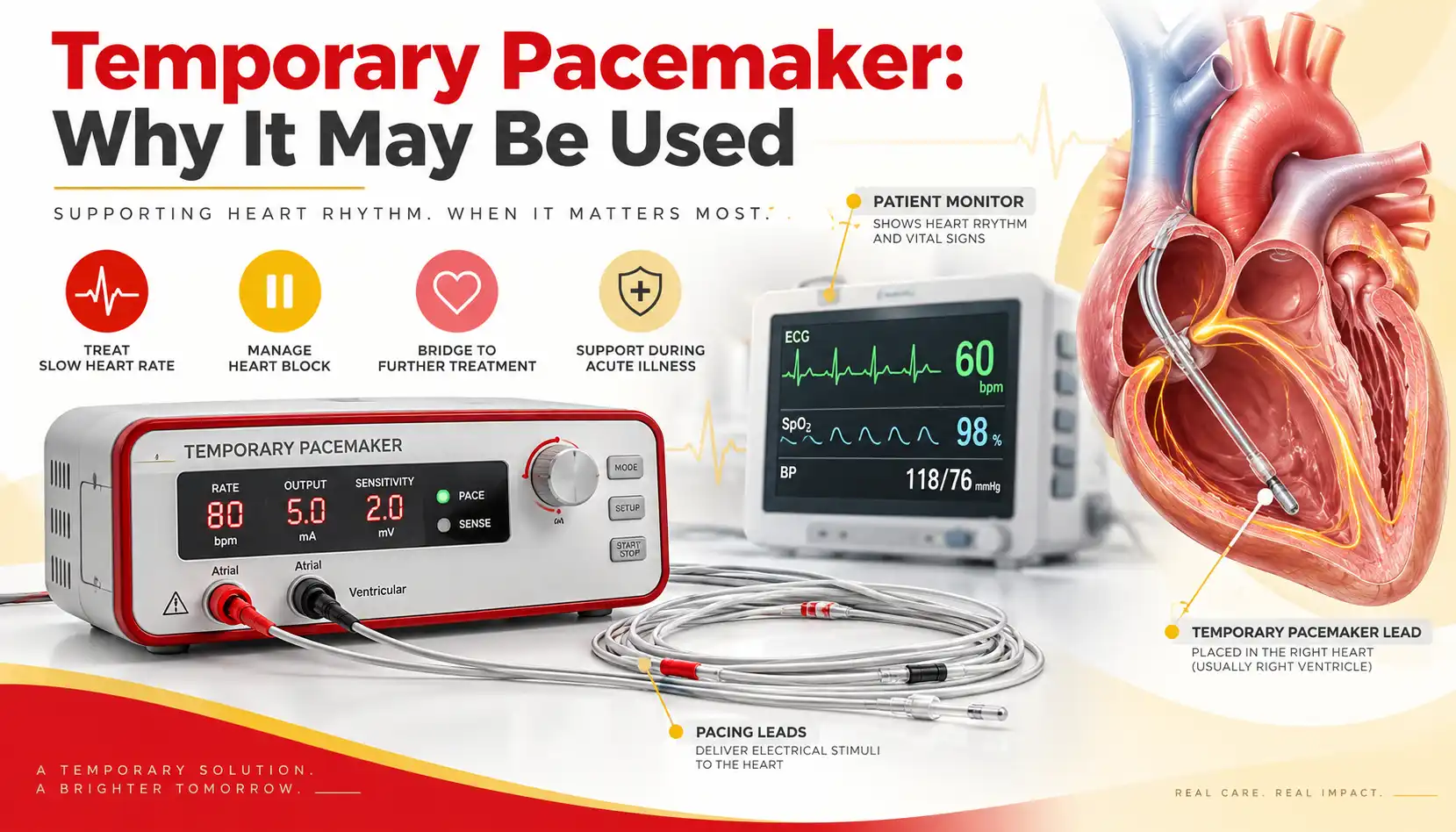
Image Disclaimer: AI-generated illustration for educational purposes.*
A temporary pacemaker helps support the heartbeat for a short period when the heart's electrical signals are not keeping it beating effectively. It may be used in an emergency, during or after certain heart procedures, or while doctors determine whether a slow rhythm will recover.
The word temporary does not mean the situation is unimportant. It means the care team needs to support and monitor the heart while treating a possible cause or deciding on the next step. Some patients recover and no longer need pacing. Others may later need a permanent pacemaker.
A pacemaker sends small electrical impulses that prompt the heart to beat when its own electrical system is not doing so adequately. A temporary system provides that support for a limited time, usually under close hospital monitoring.
In a commonly used method called temporary transvenous pacing, a doctor places a thin pacing wire through a vein and guides it to the heart. The wire connects to a generator outside the body. The team checks the heart rhythm and adjusts the device as needed.
Emergency teams may first use transcutaneous pacing, in which pads placed on the skin deliver pacing through the chest. This can provide short-term support while other treatment is arranged. After some heart operations, surgeons may leave temporary epicardial pacing wires attached to the heart so they are available during early recovery. These are different approaches; the one used depends on the clinical situation.
The main reason is a heartbeat that is too slow to support the person's circulation adequately. Doctors look at the whole patient, not only the number on a monitor. A slow rate accompanied by fainting, low blood pressure, confusion, chest discomfort or signs of poor circulation is more concerning than an isolated low reading in someone who feels well.
A temporary pacemaker may be considered in situations such as:
Not everyone with a slow pulse needs a temporary pacemaker. Clinicians first assess symptoms, the ECG, blood pressure and possible causes. The treatment may be different if the person is stable.
No. Heart block is a problem with the electrical signals that coordinate the heartbeat. A blocked coronary artery is a blood-flow problem. A heart attack can sometimes be accompanied by an electrical conduction problem, but the terms do not mean the same thing.
Your heart normally produces and conducts electrical signals that trigger each beat. A temporary pacemaker monitors the rhythm and, when programmed to do so, sends an impulse if the heart does not beat at an adequate rate.
The bedside team checks that each required impulse produces an effective heartbeat and that the device recognises the heart's own beats. The generator settings are chosen for the patient's condition and adjusted by trained clinicians. A patient should never handle the wires or change the controls.
The pacing system does not, by itself, cure the reason the rhythm slowed. Doctors continue to investigate and treat that reason while pacing protects the patient.
The steps depend on how urgently pacing is needed and which method is chosen. For transvenous pacing, the team places a wire through a vein, commonly in the neck or another suitable site, and guides it towards the heart. Imaging or other guidance may be used to check its position. The wire connects to an external generator, and staff confirm that it is working as intended.
The team will explain what medicines are used for comfort and what monitoring is required. In an emergency, there may be limited time for a detailed conversation beforehand; once the patient is stable, it is reasonable for them or their family to ask what was done and why.
Transcutaneous pacing works differently. Pads are placed on the chest and back, so a pacing wire is not inserted into a vein. It is generally a bridge during urgent care rather than a long-term solution. A conscious patient may find it uncomfortable, and the team manages that as part of treatment.
After heart surgery, temporary epicardial wires may already be in place. The team can use them if rhythm support is needed during recovery. Having temporary wires available does not mean they will necessarily be used or that a permanent pacemaker will be required.
| Feature | Temporary Pacemaker | Permanent Pacemaker |
|---|---|---|
| Purpose | Short-term support while a condition is treated or assessed | Ongoing support when a lasting pacing need is established |
| Generator | Typically remains outside the body for temporary transvenous pacing | Implanted under the skin, or contained within a leadless device |
| Setting | Close monitoring in hospital | Follow-up through scheduled device checks, sometimes with remote monitoring |
| Next step | Removed if no longer needed, or followed by a long-term plan | Continues to provide pacing as programmed |
A temporary pacemaker is not automatically a trial that every patient must complete before receiving a permanent one. In some cases, a permanent device is clearly indicated. In others, a temporary system gives the team time to see whether the heart's own rhythm improves.
There is no fixed number of hours or days that applies to everyone. The duration depends on why pacing was started, whether the underlying problem improves, what rhythm appears when the heart is assessed, and the safety of continuing with a temporary system.
A patient whose slow rhythm resolves after treatment may have the temporary system removed. If the conduction problem persists or is unlikely to recover, the team may recommend a permanent pacemaker. After a heart procedure, the decision may depend on how the rhythm behaves during monitored recovery.
The useful question to ask is: "What change are you waiting to see before deciding whether I need permanent pacing?" This gives a more meaningful answer than a general estimate of days.
A person with a temporary pacing wire is generally monitored closely. Staff watch the heart rhythm, blood pressure, symptoms and device function. They also check the insertion site and make sure the wire remains secure.
Movement instructions may depend on where the wire enters the body and how it is secured. Ask the bedside team before getting out of bed or changing position. If you notice a loose connection, new dizziness, faintness, chest discomfort or a change at the insertion site, tell staff immediately. Do not try to fix or reposition the equipment yourself.
Like other invasive procedures, temporary transvenous pacing has risks. These may include bleeding, infection, movement of the wire or a problem with pacing. The team weighs those risks against the danger of leaving an unstable slow rhythm untreated and reassesses the need for the temporary device.
Not necessarily. There are three broad possibilities:
A doctor should explain the evidence behind the recommendation, including the ECG findings, symptoms and whether a reversible cause has been addressed. If permanent pacing is advised, ask what could happen without it and what the implant and follow-up would involve.
For planned discussions about longer-term treatment, see the pacemaker implantation service in Hyderabad . The arrhythmia care service in Hyderabad also explains assessment of abnormal heart rhythms. These are informational links; they are not a booking pathway for an active emergency.
When someone needs urgent pacing, the situation can be frightening. A short set of questions can make the next conversation with the care team clearer:
The answers may change as test results return and the patient recovers. Ask the team for an update if the plan changes; do not interpret monitor numbers without their explanation.
A slow heartbeat accompanied by fainting, severe dizziness, confusion, chest pain, serious breathlessness or signs of poor circulation needs urgent medical assessment. Do not wait to see whether a home device reading improves. A smartwatch or blood-pressure monitor cannot establish whether temporary pacing is required.
If you are already in hospital with a temporary pacemaker, report new symptoms to the bedside team immediately. They can check both your condition and the device.
A temporary pacemaker provides short-term rhythm support while clinicians address an immediate problem and determine whether the heart's electrical system will recover. It may be removed once the rhythm is reliable, or it may be followed by a permanent pacemaker when a lasting need is confirmed. The reason for pacing and the plan for reassessment should be explained to the patient and family.
A doctor may use it to support a dangerously slow heartbeat while treating a possible cause, monitoring recovery after a heart procedure, or deciding whether permanent pacing is necessary.
It depends on the method. With temporary transvenous pacing, a wire is guided through a vein to the heart while the generator stays outside the body. Transcutaneous pacing uses pads on the skin.
The experience depends on the type of pacing and the person's condition. Transcutaneous pacing may be uncomfortable. For transvenous insertion, the care team explains and provides appropriate medicines for comfort.
There is no single duration for everyone. The team reassesses it regularly and removes it when it is no longer needed or makes a longer-term plan if the rhythm problem persists.
No. Some slow rhythms improve when an underlying cause is treated or after recovery from a procedure. A permanent pacemaker is considered when an ongoing pacing need is established.
Yes, in selected cases when a heart attack is accompanied by a serious slow rhythm or conduction problem. It is not required for every heart attack.
The temporary systems described here generally require close hospital monitoring. Ask the treating team about the specific device being used and the plan before discharge.
Medical Disclaimer: This article is for general informational and educational purposes only and should not be considered medical advice, diagnosis, or treatment. Please consult a qualified healthcare professional for personalized medical guidance.