
Echo Test, ECG, Holter & Troponin Test: A Complete Guide to Cardiac Diagnosis
Aug 18, 2026
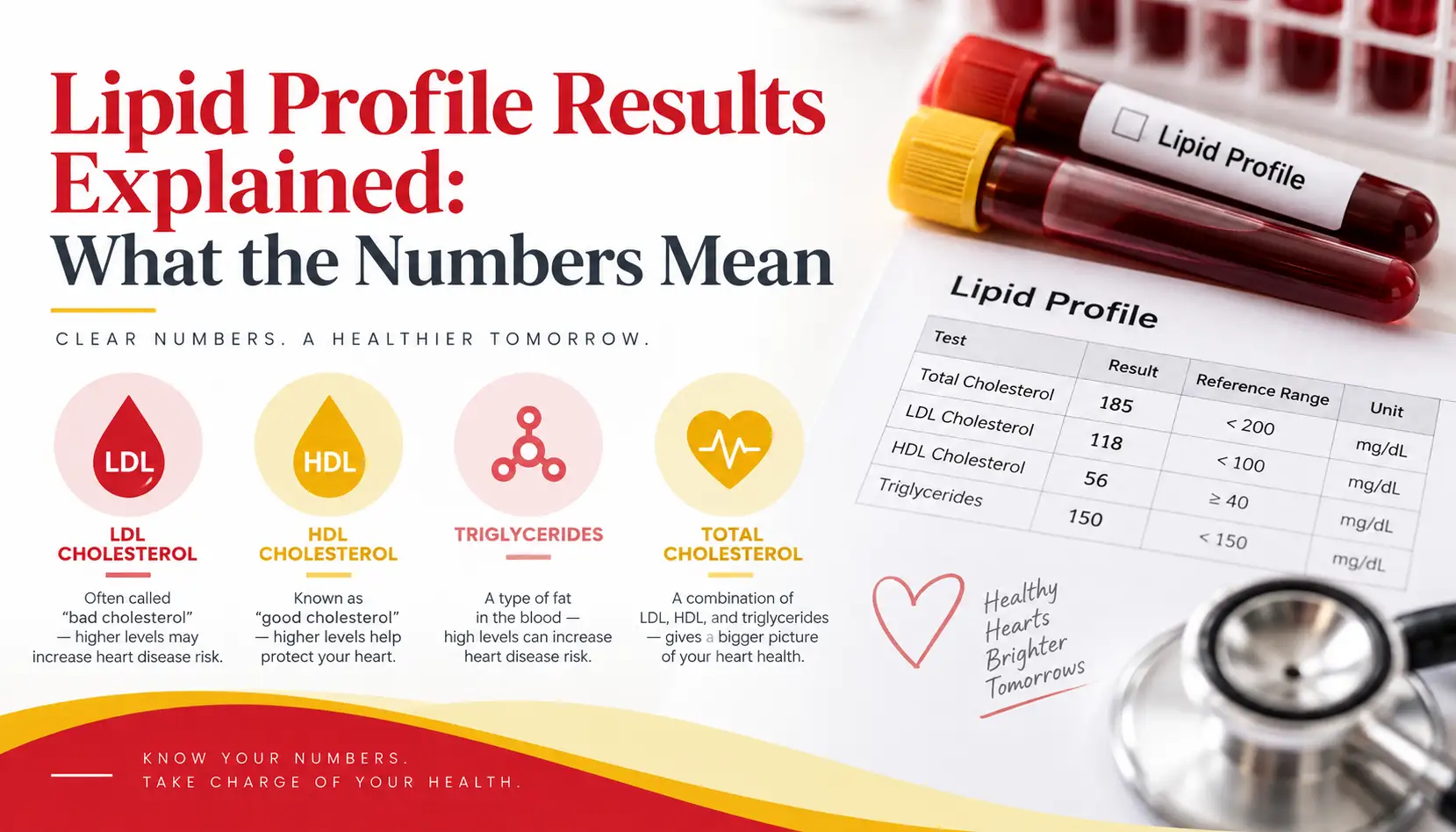
Image Disclaimer:* AI-generated illustration for educational purposes.
If you searched for “normal values of lipid profile test,” you may have a report in front of you and want to know whether its numbers are safe. A reference range is a useful starting point, but it is not the whole answer. The same LDL cholesterol result may lead to different advice for someone with no known heart disease and someone who has already had a heart attack.
A lipid profile also called a lipid panel measures cholesterol and other fats in your blood. This guide explains the common terms on the report, how to read them together, and which questions to take to your doctor. It cannot determine your personal treatment target or diagnose a blocked artery.
Many reports use mg/dL (milligrams per decilitre). Check the unit printed beside your result before comparing it with any chart.
| Report item | Common adult reference point | What to remember |
|---|---|---|
| Total cholesterol | Below 200 mg/dL is commonly described as desirable | It combines different types of cholesterol and does not tell the whole story. |
| LDL cholesterol | Below 100 mg/dL may be a goal for some people | A person at higher cardiovascular risk may need a lower individual goal. |
| HDL cholesterol | Below 40 mg/dL in men or 50 mg/dL in women is generally considered low | HDL contributes to risk assessment, but it is not interpreted or treated on its own. |
| Triglycerides | Below 150 mg/dL is generally considered within the usual range | A high result needs interpretation alongside the rest of the report and your health history. |
| Non-HDL cholesterol | Often below 130 mg/dL as a general reference point | It is calculated from total cholesterol minus HDL; individual goals may differ. |
These are broad adult reference points, not a self-treatment chart. Laboratories may display their ranges differently. Your clinician may recommend a more specific target based on your medical history, diabetes, blood pressure, smoking status, family history and whether you already have cardiovascular disease.
Total cholesterol is the combined amount of cholesterol measured in your blood. It is often the first number people notice, but it should not be the only one they read.
For example, two people may have similar total cholesterol while having different LDL and HDL levels. Their overall risks may also differ because of age, diabetes, blood pressure or a previous heart event. Treat total cholesterol as the opening line of the report, not its conclusion.
LDL stands for low-density lipoprotein. It is often called “bad” cholesterol because higher levels contribute to plaque buildup in arteries over time. That buildup can increase the risk of heart attack and stroke.
There is no single LDL value that is ideal for everyone. Someone with known coronary artery disease or a previous heart attack may be advised to aim lower than someone without those conditions. This is why a result marked “within range” by a laboratory may still need attention in a higher-risk patient.
Your report may show LDL as calculated or directly measured. If you are unsure how the result was obtained or whether unusually high triglycerides affect its interpretation, ask the clinician reviewing your report.
HDL stands for high-density lipoprotein and is commonly called “good” cholesterol. It helps carry cholesterol away from arteries. A low HDL level can be one part of an unfavourable risk picture.
However, a high HDL number does not cancel out a high LDL number. HDL is also not usually treated as a stand-alone medication target. Rather than focusing on increasing one number, your clinician will consider the entire lipid profile and your overall health.
Triglycerides store energy from food. Their level can be influenced by factors such as diet, alcohol, body weight, diabetes, medicines and whether the test was taken after eating.
A triglyceride result above the usual range should be discussed, particularly when it occurs alongside high LDL or low HDL. Very high triglycerides need prompt clinical review because they can raise the risk of pancreatitis, a serious inflammation of the pancreas. Do not try to interpret or treat a very high result from an online chart alone.
Some reports include non-HDL cholesterol. If yours does not, the calculation is:
It represents cholesterol carried by particles other than HDL. It can add useful information, especially when a clinician is assessing overall cardiovascular risk. As with LDL, the appropriate goal depends on the person, not just a generic laboratory range.
Your report may also show VLDL, another cholesterol-carrying particle. It is often estimated rather than measured directly. For most readers, the best first step is to understand LDL, HDL, triglycerides and non-HDL cholesterol rather than making a decision from VLDL alone.
ApoB and lipoprotein(a), written Lp(a), are additional tests that may help in selected risk assessments. They are not necessarily included in a standard lipid profile. Lp(a) is largely inherited; a clinician may discuss testing it, particularly when reviewing long-term cardiovascular risk or a strong family history. Do not assume that a standard lipid panel has measured it.
First, confirm the units and test date. A value in mg/dL should not be compared directly with a chart using mmol/L. If you are comparing two reports, check that they use the same units.
Next, look at the complete panel, not just the number highlighted in red. Identify total cholesterol, LDL, HDL and triglycerides. If non-HDL cholesterol is listed, include it in your discussion.
Then, consider your circumstances. Have you had a heart attack or stroke? Do you have diabetes, high blood pressure or known coronary artery disease? Does a close family member have high cholesterol or early heart disease? Are you already taking cholesterol-lowering medicine? These details affect what a result means and what happens next.
Finally, compare with earlier results if you have them. A change over time may be more useful than a single reading. Bring previous reports to your appointment rather than relying on memory.
No. A lipid profile helps assess risk; it does not show whether a coronary artery is narrowed. A result within common reference ranges cannot rule out coronary artery disease. Similarly, a high LDL result does not prove that a particular artery is blocked.
If you have chest discomfort or other symptoms, tell a doctor about them directly. Do not wait for a routine cholesterol review to address new or concerning symptoms. A clinician can decide whether you need a separate heart assessment.
A lipid profile may be ordered fasting or non-fasting. Your doctor or laboratory should tell you how to prepare for your test. Fasting may be requested in certain situations, particularly when triglycerides need closer assessment.
If you were asked to fast, confirm the instructions with the testing team, including whether you can drink water and how to handle regular medicines. Do not stop prescribed medicine on your own. If you were not fasting, tell the clinician interpreting your results; that information may matter when they decide whether any measurement should be repeated.
The result is a snapshot, not a fixed label for life. Cholesterol and triglyceride levels may change with eating patterns, physical activity, weight, alcohol use, medicines and some medical conditions. Pregnancy and inherited conditions can also affect lipid levels.
This does not mean every result outside a reference range is due to lifestyle. Some people have strongly inherited high LDL cholesterol and may need assessment even if they follow healthy habits. Equally, it is possible to have cardiovascular risk despite a report that does not look dramatically abnormal.
If a number surprises you, ask whether the test should be repeated, whether another condition might be contributing, and what goal is appropriate for you. Avoid changing treatment after one report without reviewing it with your care team.
The next step is a conversation about overall risk, not a decision based on total cholesterol alone. Your clinician may consider your age, health conditions, blood pressure, smoking status, family history and previous cardiovascular events. Depending on that assessment, a plan may include:
If medicine is prescribed, take it as directed and discuss concerns or side effects rather than stopping it yourself. Ask what result you are aiming for and when it should be rechecked.
For readers with known or suspected arterial disease, the coronary artery disease care in Hyderabad page explains the related clinical service. If you need an assessment of your heart risk and lipid results, a cardiology consultation in Hyderabad can help connect the report with your personal history. These links are for planned care; new or severe chest symptoms require urgent medical attention.
Arrange a review if your report has a result outside the laboratory range, you have been told your LDL goal is lower than the printed range, or you have diabetes, known heart disease or a strong family history. Also seek advice if you are unsure whether you should continue an existing medicine after a new result.
High cholesterol usually has no obvious symptoms. A lipid profile is important because it can identify a risk factor before symptoms appear. But if you develop new, severe or persistent chest pain, especially with breathlessness, sweating or faintness, seek emergency medical help rather than waiting for a cholesterol appointment.
A lipid profile is most useful when its numbers are read together and in context. LDL, HDL, triglycerides and non-HDL cholesterol each answer a different question. Common reference ranges can help you understand the report, but your personal goal depends on your cardiovascular risk and medical history. Bring the full report and any previous results to a clinician who can explain what, if anything, you need to do next.
Common adult reference points include total cholesterol below 200 mg/dL and triglycerides below 150 mg/dL. LDL and non-HDL goals depend on personal cardiovascular risk. Your clinician should interpret the complete report rather than one number alone.
LDL cholesterol is an important number because higher levels contribute to plaque buildup in arteries. However, treatment decisions also depend on the rest of the lipid profile and factors such as diabetes, blood pressure and previous heart disease.
No. HDL provides useful information about risk, but a high HDL result does not cancel out the risk associated with high LDL. Both numbers should be considered with your overall health.
No. A lipid profile measures cholesterol and triglycerides; it does not show whether a heart artery is blocked. Symptoms or other risk factors may still need separate assessment.
Not always. Lipid tests may be performed fasting or non-fasting. Follow the instructions from your doctor or laboratory, and tell the clinician reviewing the report if you had eaten before the test.
Non-HDL cholesterol is total cholesterol minus HDL cholesterol. It represents cholesterol carried by particles other than HDL and can provide additional information when your clinician assesses cardiovascular risk.
Do not stop prescribed medicine based on one report. Your result may be within your target range because the medicine is working. Discuss any change with the clinician who manages your treatment.
Medical Disclaimer: This article is for general informational and educational purposes only and should not be considered medical advice, diagnosis, or treatment. Please consult a qualified healthcare professional for personalized medical guidance.