
Echo Test, ECG, Holter & Troponin Test: A Complete Guide to Cardiac Diagnosis
Aug 18, 2026
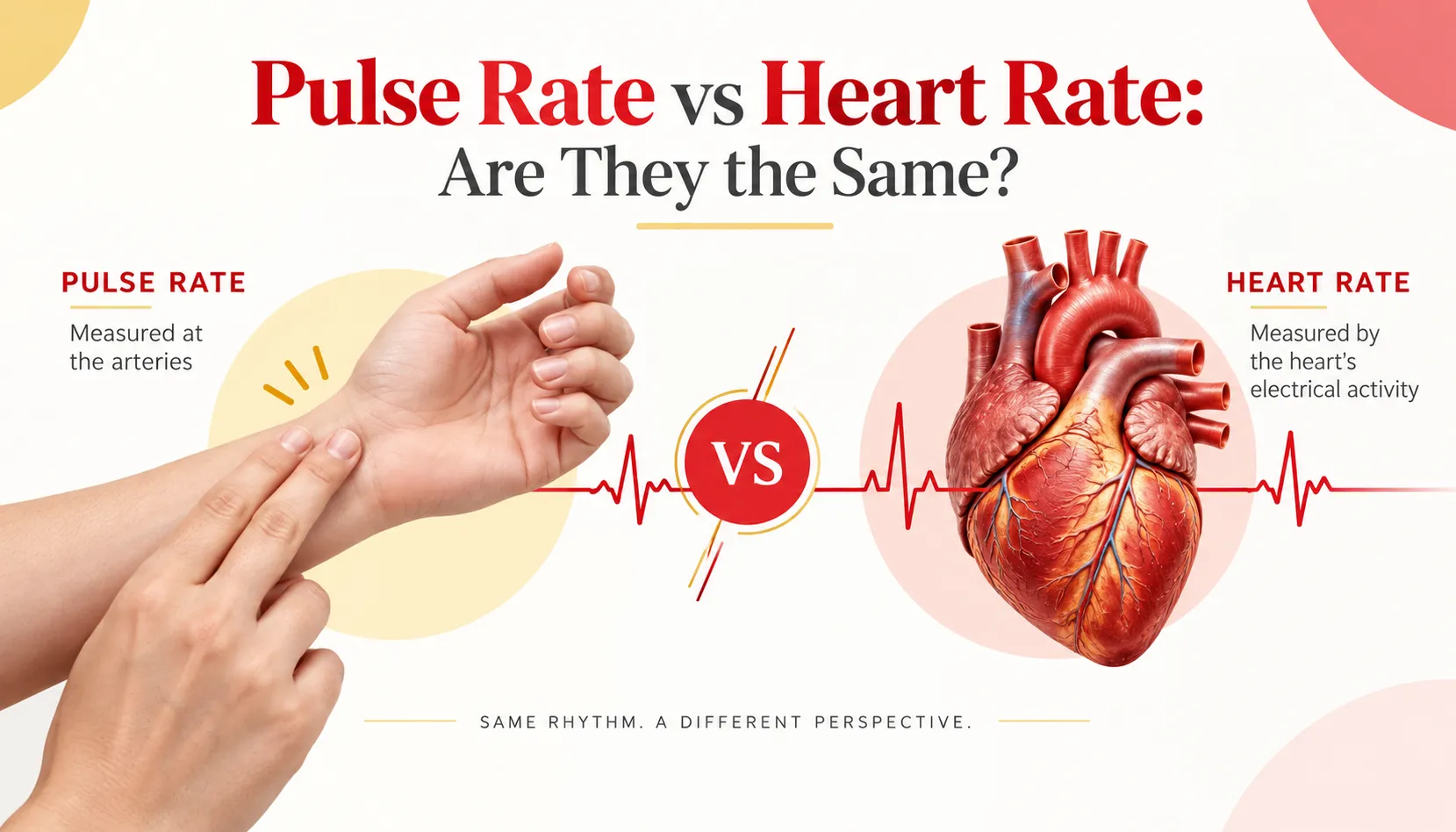
Image Disclaimer: AI-generated illustration for educational purposes.*
The difference between heart rate and pulse rate is what each measures. Heart rate is the number of times your heart beats in a minute. Pulse rate is the number of pressure waves you can feel in an artery, usually at your wrist, in a minute. For most people, the two numbers are the same or very close.
If your watch shows one number and you count another at your wrist, it does not automatically mean something is wrong. The readings may have been taken at different moments, or one may be inaccurate. But a repeatedly irregular pulse, a persistent difference, or a reading accompanied by symptoms deserves medical attention.
| Feature | Heart rate | Pulse rate |
|---|---|---|
| What it measures | Heartbeats per minute | Arterial pulse waves felt or detected per minute |
| Where it is checked | By listening to the heart or recording its electrical activity | At an artery such as the wrist, or by a device that detects changes in blood flow |
| Typical relationship | Usually matches the pulse rate | Usually matches the heart rate |
| What the number alone cannot tell you | The exact cause of a fast, slow or irregular rhythm | Whether every heartbeat is normal or which rhythm is present |
Both are commonly reported in beats per minute (bpm). In everyday conversation, people often use pulse and heart rate interchangeably. The distinction matters most when the rhythm is irregular or a device reading does not fit how you feel.
Your heart rate tells you how many times your heart beats each minute. It changes throughout the day. It normally rises during exercise and may also change with stress, fever, medicines or illness. It generally slows again when you rest.
A clinician can listen to the heartbeat with a stethoscope. An electrocardiogram (ECG) records the electrical activity that controls the heartbeat and provides information about both rate and rhythm. It can help identify an irregular rhythm that a simple number on a screen cannot explain.
Heart rate is not the same as blood pressure. Heart rate counts beats per minute; blood pressure measures the force of blood against artery walls. One number does not reliably tell you the other.
Each time the heart pumps blood, a pressure wave travels through the arteries. You can often feel that wave as a pulse at your wrist. Your pulse rate is the number of waves you count in one minute.
Checking your pulse can give you two useful observations:
The second observation matters. A pulse of 78 bpm that feels uneven may need a different discussion from a steady pulse of 78 bpm. Neither observation, however, provides a diagnosis on its own.
Usually, yes. When each heartbeat pumps enough blood to produce a detectable wave at your wrist, the counts should match or be very close if measured at the same time.
Sometimes they differ. With certain irregular heart rhythms, some heartbeats may produce a pulse wave that is too weak to feel clearly at the wrist. A clinician may find more heartbeats than wrist pulses; this is called a pulse deficit. It is not something you can confirm reliably by comparing two devices at home.
There are also simpler reasons for an apparent difference. You may have taken the readings minutes apart, moved while a sensor was measuring, or counted too briefly when the rhythm was uneven. Before drawing conclusions from a mismatch, consider how and when each number was obtained.
Rest, then recheck your wrist pulse for a full minute. If the difference repeatedly appears, the pulse feels irregular, or you have symptoms, discuss it with a clinician. Do not use a matching pair of numbers as proof that your heart rhythm is normal, either.
For most adults who are calm and at rest, 60–100 bpm is a commonly used resting range. It is a guide, not a diagnosis. A physically active person may have a lower resting rate. Medicines and health conditions can also affect the number.
A single reading outside that range does not tell you the cause or whether treatment is needed. The context matters: Were you resting? Do you feel unwell? Is reading unusual for you? Has it remained high or low when repeated?
Children’s rates differ from adult rates, so an adult resting range should not be used to interpret a child’s pulse. If your doctor has given you an individual target because of a heart condition or medicine, follow that advice rather than a general chart.
You do not need special equipment to feel your wrist pulse:
Use your fingers rather than your thumb, which has its own pulse. If you cannot find the wrist pulse easily, do not press harder and harder or conclude that your heart is not beating. Ask a healthcare professional to show you how to check it.
For a meaningful comparison over time, try to take readings under similar conditions for example, after sitting quietly, not immediately after climbing stairs. Record symptoms alongside the number. “Pulse 104 after walking, settled after resting” tells a clinician more than “pulse 104” alone.
A wearable or finger device can be useful for spotting a change and recording when it happened. However, devices use different methods, and a displayed pulse number is not the same as a clinical ECG interpretation. Movement, sensor contact and an irregular rhythm can make a reading harder to interpret.
Some watches can record an ECG or send an irregular-rhythm alert. If yours does, save the recording or alert to show your clinician. An alert is a reason to discuss your rhythm, not a diagnosis to treat yourself. Likewise, the absence of an alert does not rule out every rhythm problem.
If a reading looks surprising, check how you feel, rest and repeat it. Symptoms matter more than a reassuring-looking device number. Seek urgent care if you feel seriously unwell.
An occasional awareness of your heartbeat does not always signal a serious condition. But if your pulse is repeatedly irregular, races without an obvious reason, or is accompanied by palpitations, dizziness or unusual breathlessness, a medical assessment can help find out why.
An ECG records the heart’s electrical rhythm at the time of the test. If episodes come and go, a brief ECG may not capture them. A clinician may then recommend a portable rhythm monitor worn for longer while you go about your normal activities.
For persistent or recurring concerns, an arrhythmia evaluation in Hyderabad can help determine which assessment is appropriate. If an ECG has been recommended, the ECG test in Hyderabad service page explains that option. These links are for non-emergency planning, not a substitute for urgent care.
Arrange a medical appointment if your pulse repeatedly feels irregular, your resting rate is persistently unusual for you, or you keep noticing palpitations. Tell the clinician about any medicines you take and bring a record of the readings and symptoms. Do not change a prescribed medicine because of a pulse reading without medical advice.
Seek emergency medical help if a fast, slow or irregular heartbeat occurs with chest pain, severe breathlessness, fainting or a feeling that you may pass out. Do not wait to collect more readings or for a smartwatch to confirm a problem.
Heart rate counts the heart’s beats; pulse rate counts the waves those beats create in an artery. Most of the time, they match. A difference on two devices is not automatically dangerous, but a repeatedly irregular pulse, persistent mismatch or accompanying symptoms should be assessed. Pay attention to the rhythm and how you feel, not only the number.
Usually, they are the same or very close. Heart rate counts heartbeats, while pulse rate counts the pressure waves felt in an artery. In some irregular rhythms, not every heartbeat produces a pulse you can feel clearly.
Yes, it can happen when some heartbeats do not create a strong enough pulse wave to detect at the wrist. Readings taken at different times or inaccurate device readings can also appear different. A clinician can assess a persistent mismatch.
No. Pulse rate is the number of arterial pulses per minute. Blood pressure measures the force of blood against artery walls. A blood pressure monitor may display a pulse rate, but the two measurements mean different things.
For most adults at rest, 60–100 beats per minute is a common reference range. Fitness, medicines, illness and other factors can affect an individual’s rate, so a reading needs context.
Count for a full 60 seconds, particularly if the beats feel irregular. This gives you a rate and lets you notice whether the rhythm feels steady.
A smartwatch alert or recording can provide useful information, but a clinician should assess what it means. An ECG or longer rhythm monitor may be needed to identify an irregular rhythm.
Seek emergency medical help if a fast, slow or irregular heartbeat comes with chest pain, severe breathlessness, fainting or a feeling that you may pass out. Do not wait for another device reading.
Medical Disclaimer: This article is for general informational and educational purposes only and should not be considered medical advice, diagnosis, or treatment. Please consult a qualified healthcare professional for personalized medical guidance.