Echo Test, ECG, Holter & Troponin Test: A Complete Guide to Cardiac Diagnosis
Aug 18, 2026
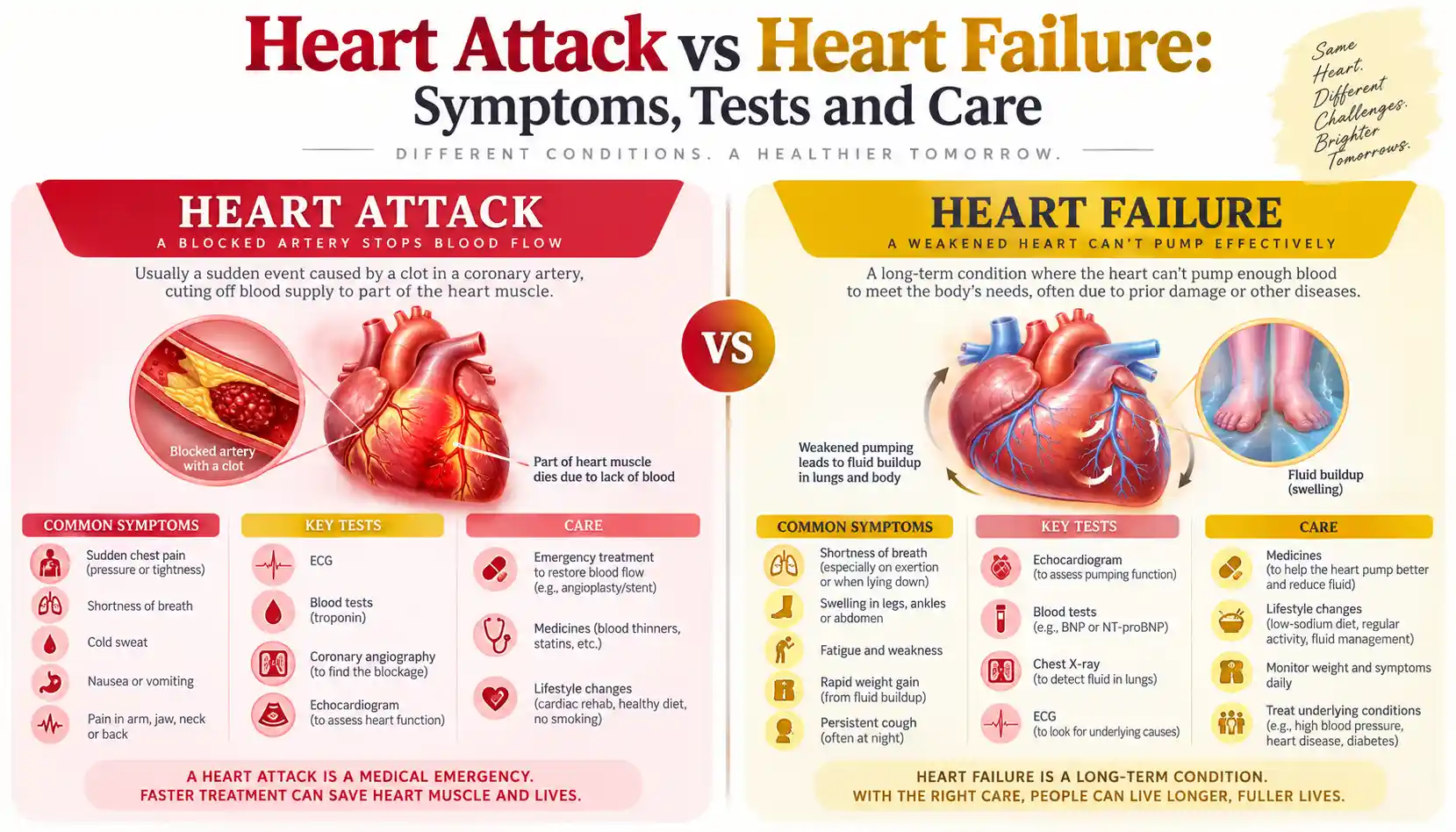
Image Disclaimer: AI-generated illustration for educational purposes.*
The difference between heart attack and heart failure is easier to understand if you think about blood flow and pumping. A heart attack happens when blood flow to part of the heart muscle is suddenly reduced or blocked. Heart failure means the heart is not pumping or filling well enough to meet the body’s needs. A heart attack can lead to heart failure, but the two are not the same condition.
Their symptoms can overlap, especially breathlessness and fatigue. That is why it is unsafe to decide which one you have from symptoms alone. New chest discomfort or severe breathing difficulty needs emergency medical attention, not an online self-diagnosis.
| Feature | Heart attack | Heart failure |
|---|---|---|
| Main problem | Blood flow to part of the heart muscle is suddenly reduced or blocked | The heart cannot pump or fill effectively enough |
| Typical pattern | Often develops suddenly, although symptoms may start gradually or come and go | Often develops over time, but can worsen suddenly |
| Common symptoms | Chest pressure or discomfort, pain in the upper body, breathlessness, sweating or nausea | Breathlessness, tiredness, reduced ability to exercise, and swelling in the legs or feet |
| Tests often used | ECG, troponin blood tests and, when needed, coronary angiography | Examination, echocardiogram, blood tests and other tests to identify the cause |
| Care priority | Immediate assessment and treatment to protect the heart muscle | Treatment of the cause, symptom relief and ongoing follow-up; sudden worsening may need emergency care |
These patterns are helpful, but they are not rules for diagnosing yourself. A heart attack can occur without obvious chest pain, and sudden heart failure can be an emergency.
A heart attack is also called a myocardial infarction. It occurs when part of the heart muscle does not receive enough blood and oxygen. Often, plaque in a coronary artery becomes disrupted and a blood clot forms, sharply reducing blood flow.
The longer the reduced blood flow continues, the greater the risk of heart muscle damage. This is why suspected heart-attack symptoms must be assessed urgently. Treatment depends on the type of heart attack and the person’s condition; it may include medicines and a procedure to restore blood flow.
A heart attack does not necessarily mean the heart has stopped beating. That situation is called cardiac arrest, which is a different emergency although a heart attack can sometimes trigger it.
Watch for:
Symptoms can differ from person to person. Some begin mildly, then intensify; others ease and return. If you suspect a heart attack, seek emergency medical help immediately. Do not wait for a routine appointment or drive yourself to the hospital.
Despite its name, heart failure does not mean the heart has stopped. It means the heart is not working as effectively as it should. Blood and fluid may back up, while the body may receive less blood than it needs during activity.
Heart failure may develop gradually because of coronary artery disease, high blood pressure, a heart-muscle condition, a valve problem or other causes. It can also appear or worsen suddenly. A previous heart attack is one possible cause because damaged heart muscle may not work as well afterwards, but many people develop heart failure without ever having had a heart attack.
A doctor may describe heart failure by which side of the heart is affected or by the heart’s ejection fraction, a measure of how much blood the main pumping chamber pushes out with each beat. Importantly, a person can have heart failure even when the ejection fraction is in the normal range. The diagnosis takes more than one number.
Symptoms may include:
These symptoms are not unique to heart failure. Lung conditions, anaemia and other problems may cause similar complaints. A medical assessment is needed to find the cause.
Breathlessness is the most important overlap. It can happen during a heart attack, in heart failure, or for a reason unrelated to either. Fatigue and light-headedness can also occur with both conditions.
The overall pattern can offer clues. New chest pressure with sweating or nausea raises concern for a heart attack. Breathlessness that has gradually increased alongside leg swelling may suggest heart failure. But an individual may not follow the typical pattern. Someone with known heart failure can also have a heart attack; someone having a heart attack may suddenly develop heart-failure symptoms.
Yes. If a heart attack damages enough heart muscle, the heart may struggle to pump effectively afterwards. Heart failure may be noticed during the initial hospital stay or develop later. The risk is not the same for everyone; it depends on factors including the extent of damage and how the heart recovers.
This connection is one reason follow-up after a heart attack matters. Your team may assess heart function, review symptoms, prescribe medicines and discuss cardiac rehabilitation. Not everyone who has a heart attack develops heart failure, and heart failure has many causes other than heart attacks.
A clinician considers the timing of symptoms, your medical history, examination and test results together. Some tests help identify a heart attack, while others help show how well the heart is working. The same person may need assessment for both conditions.
An ECG records the heart’s electrical activity and may show changes associated with a heart attack. A normal or unclear initial ECG does not always settle the question, so the team may repeat it if concern remains.
A troponin blood test can help detect heart-muscle injury. Doctors interpret the result in context and may take repeat samples. Depending on the findings, they may recommend coronary angiography to examine the coronary arteries and plan treatment.
These tests belong in a clinical pathway. A smartwatch reading or a home blood-pressure measurement cannot rule out a heart attack.
An echocardiogram, or heart ultrasound, shows the heart’s structure and how it pumps. Blood tests such as BNP or NT-proBNP may help clinicians assess whether heart failure is likely. They may also check kidney function and look for other causes of the symptoms. An ECG and chest imaging may provide further information.
No single test should be read in isolation. For example, an echocardiogram can show a normal ejection fraction even when a person has a form of heart failure. Your doctor will explain what the results mean for your particular symptoms.
Yes. A suspected heart attack is an immediate medical emergency. The first priority is to assess the situation and, where appropriate, restore blood flow to the affected heart muscle. The care team then plans medicines, follow-up and rehabilitation to lower the chance of further problems.
Heart-failure care focuses on the underlying cause, improving symptoms and helping the person stay well over time. Depending on the type and severity, treatment may include prescribed medicines, management of blood pressure or other conditions, lifestyle changes, and sometimes a device or procedure. Someone whose heart failure suddenly worsens may need hospital treatment.
The treatments are not interchangeable. Do not start, stop or change heart medicines based on an article or an individual test result.
Get emergency medical help for new or persistent chest pressure or pain; chest symptoms with sweating, nausea, faintness or breathlessness; or severe breathing difficulty. Someone with known heart failure also needs urgent assessment if breathing suddenly becomes much worse, particularly at rest.
If you are unsure whether a symptom is a heart attack, treat the possibility seriously. An appointment-booking form is not an emergency service.
If you have gradually increasing breathlessness, swelling, fatigue or reduced ability to exercise, arrange a medical appointment. If you already have heart failure, tell your care team when your symptoms change or you develop new swelling; follow the action plan they have given you.
For information about hospital care, readers can explore heart attack treatment in Hyderabad and heart failure treatment in Hyderabad. These service pages support an informed conversation, but do not delay emergency care to read or book online.
If your symptoms are not an emergency, a little preparation can make the consultation more useful. Note when symptoms began, whether they occur during activity or at rest, whether you need extra pillows to sleep comfortably, and whether swelling is new. Bring your medicine list and previous heart-test reports.
You might ask: “What is causing my breathlessness?”, “Which test would help answer that?”, “What changes should make me seek urgent help?” and “When should I follow up?” These questions are more useful than trying to choose a diagnosis before you are examined.
A heart attack is primarily an urgent blood-flow problem; heart failure is a problem with how effectively the heart works. They can be connected, and their symptoms can overlap. The safest approach is to seek emergency help for sudden warning signs and arrange a medical assessment for ongoing or worsening symptoms.
No. A heart attack is a sudden problem with blood flow to part of the heart muscle. Heart failure means the heart is not pumping or filling effectively enough. A heart attack can sometimes lead to heart failure.
Yes. Heart failure can develop for several reasons, including high blood pressure, heart-valve disease and heart-muscle conditions. A past heart attack is only one possible cause.
Yes. A heart attack can damage the heart muscle and lead to heart failure. Someone who already has heart failure can also have a heart attack.
It can occur with either condition and with other illnesses. Sudden or severe breathlessness needs urgent assessment, especially when it occurs with chest discomfort, sweating or faintness.
No. In heart failure, the heart is still beating but is not pumping or filling as effectively as the body needs. A heart that suddenly stops pumping effectively is cardiac arrest, a different emergency.
Doctors use symptoms and examinations together with tests. An ECG and troponin blood tests are central to assessing a suspected heart attack. An echocardiogram and blood tests such as BNP or NT-proBNP can help assess heart failure.
Both can be serious, but they are not directly comparable. A suspected heart attack needs immediate emergency care. Heart failure may need long-term treatment and follow-up, while sudden worsening can also become an emergency.
Medical Disclaimer: This article is for general informational and educational purposes only and should not be considered medical advice, diagnosis, or treatment. Please consult a qualified healthcare professional for personalized medical guidance.